Hoya amicabilis Care Guide
Hoya Amicabilis — Apocynaceae family, exported from our East Java desk and shipped bare-root. Light, water, humidity, substrate, temperature, propagation and the dispatch details to confirm before transit, in one place.
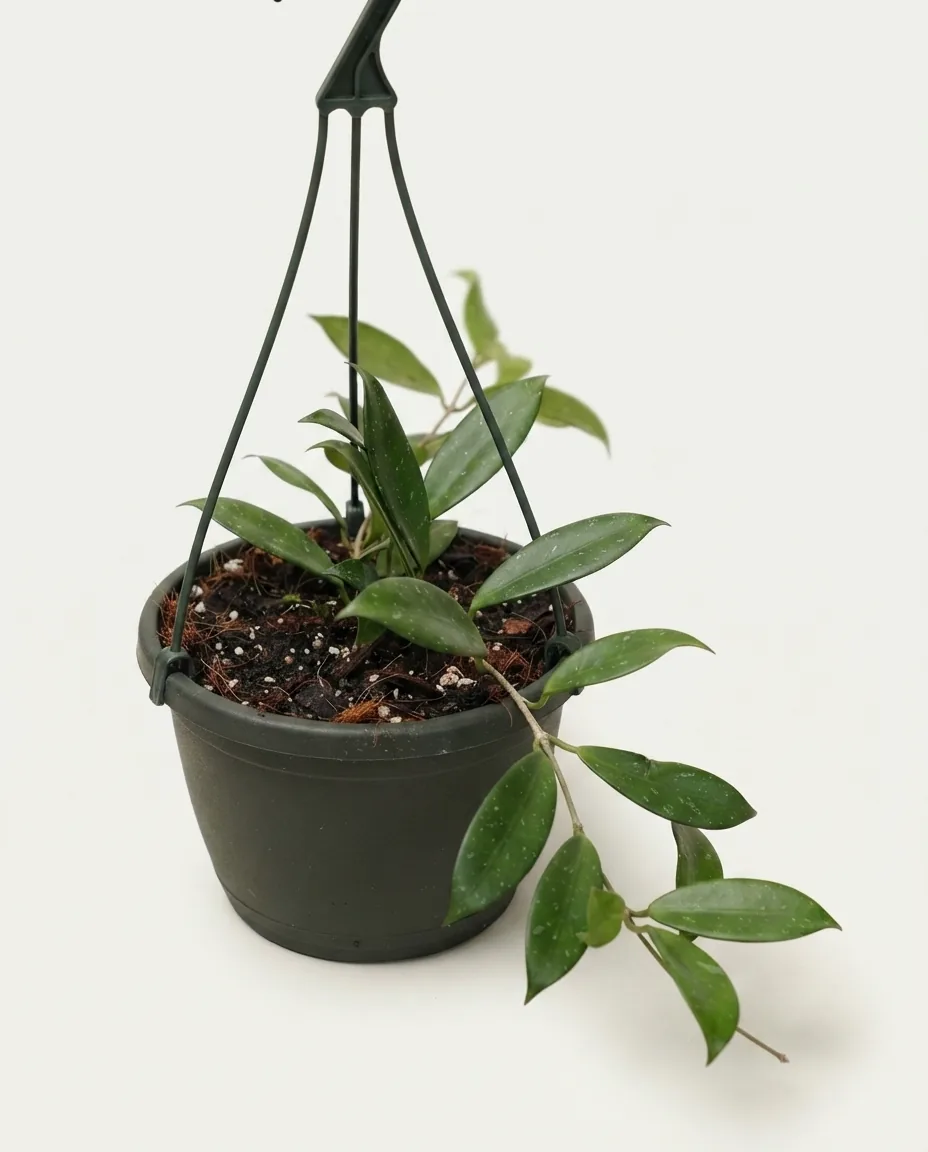
Rahayu & Rodda’s 2019 description identifies Hoya amicabilis as a shrubby epiphyte with horizontally held leafy stems. Its leaves are elliptic to lanceolate, 5–8 × 1.5–3 cm. Plan space for spreading branches rather than expecting a twining moss-pole plant.
Growing Hoya amicabilis
- LightGeneral Hoya guidance: bright, indirect lightRHS recommends a bright position protected from hot sun. This is general Hoya guidance; the species description does not establish indoor light requirements for Hoya amicabilis.
- WaterGeneral Hoya guidance: water according to conditionsKeep the mix moist during active growth, let excess water drain, and reduce watering when growth slows. This general RHS guidance does not establish a weekly schedule for this species.
- HumidityGeneral Hoya guidance: humid airRHS advises humid conditions for Hoyas. Neither reference supplies a tested relative-humidity target or an indoor acclimatisation protocol for Hoya amicabilis.
- SubstrateGeneral Hoya guidance: an airy, freely draining mixRHS suggests orchid bark, peat-free compost and perlite for Hoyas. This is a general starting point, not a substrate recipe tested for this species.
- TemperatureGeneral Hoya guidance: warmth; species limits unverifiedRHS gives 16–24 °C as general spring and summer guidance for Hoyas. This is not a measured tolerance range for Hoya amicabilis; its collection elevation does not establish indoor limits.
- PropagationGeneral Hoya methods: cuttings or layeringRHS describes stem cuttings and layering for Hoyas generally. The cited sources do not establish a species-specific rooting time or success rate, or how the offered plants were propagated.
Sources and growing guidance
- Rahayu & Rodda (2019): the original species description
Supports the identity, growth habit, flowers and historical locality described here; it is not an indoor cultivation or shipping trial.
- Royal Horticultural Society: How to grow hoya
General Hoya growing advice. Its recommendations are a starting point and have not been validated for this species by the cited paper.
The flowers are bell-shaped, 5–8 mm across, yellow and becoming orange with age. Sterile plants resemble Hoya ignorata; floral characters distinguish them. Ask for flowering photographs linked to the offered stock, since foliage photographs alone may not resolve identity.
Bare-root export and transit
In the original paper, the species was known only from its type locality at Bruno, Purworejo, Central Java, at 900–1000 m elevation. That habitat record is not a cultivation trial. The paper does not establish easy care, flowering speed, shipping resilience or a recovery timetable.
How every consignment is prepared
- Root preparation100% Bare-root washed (zero soil, zero unsterilized peat).
- TreatmentSystemic broad-spectrum anti-fungal & bactericide dip treatment.
- Root wrapSterile Chilean AAA damp sphagnum moss protective root-envelope.
- Dispatch conditions to confirmConfirm the packing method, root condition, growing conditions before dispatch and proposed route with the export desk. The cited sources do not establish a species-specific transit window or recovery time.
Questions buyers ask
Does Hoya amicabilis need a moss pole?
Its described habit is shrubby, with horizontally held leafy stems. A moss pole is not an established requirement; ask for a current whole-plant photograph to assess its spread and support needs.
When will Hoya amicabilis flower?
The cited sources do not establish a time to flowering for this species. Ask whether the offered stock has flowered and request dated photographs; a flower image does not promise buds on your plant.
What should I confirm before ordering?
Request current stock photographs, plant dimensions, root condition, propagation history and dispatch format. Confirm packing and the proposed route with the export desk; the cited sources provide no species-specific transit survival or recovery guarantee.
What the published literature calls this plant
A protologue is the original published description of a species. It helps you compare diagnostic characters — the features used to distinguish that species from similar plants. Compare those characters with photographs of the offered plant and its documented mother plant where available. A species description provides identification evidence; cultivation advice also needs evidence about growing conditions, as explained in the guidance above.
Hoya amicabilis S.Rahayu & Rodda · Apocynaceae
The accepted name in the GBIF Backbone Taxonomy, the plant taxonomic backbone.
Protologue citation: Rahayu, S., & Rodda. (2019). In: Nordic J. Bot. 37(12)-E02563: 2.
- Hoya amicabilis sp. nov. (Apocynaceae, Asclepiadoideae), from Java discovered on Facebook — Nordic Journal of Botany (2019), the protologue
Taxonomy from the GBIF Backbone Taxonomy. Open the backbone record.
Order Hoya Amicabilis
The supplier lists Wax Plant and grade A+; these fields do not specify plant size, propagation method, batch or rooting status. Confirm those details for the offered stock before ordering. The minimum export consignment is 20 plants across single or mixed varieties; volume discounts start at 30 plants.
The commercial pages behind this guide
- How to import plants from IndonesiaThe full document-to-door sequence: bare-root preparation, Barantan certification, destination permits, inspection and arrival.
- Estimated shipping ratesFreight basis and indicative transit for a consignment, with the variables that move the price.
- Wholesale termsMinimum order, volume tiers, deposit, the document set, and the split of responsibility between exporter and importer.
- Live arrival guaranteeWhat the guarantee covers and how to report condition within the arrival window.