Philodendron martianum Care Guide
Philodendron Martianum — Araceae family, grown in our East Java nursery and shipped bare-root. Light, water, humidity, substrate, temperature, propagation and what happens to the plant in transit, in one place.
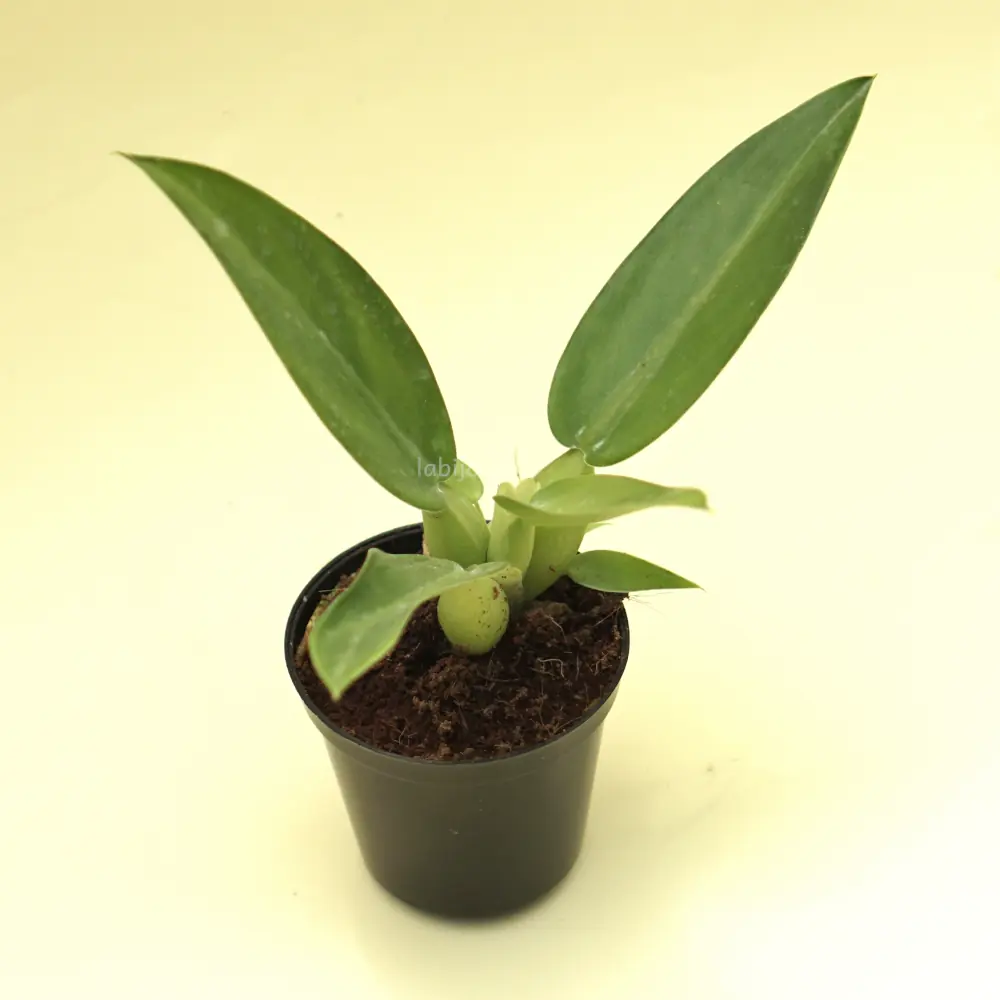
Martianum is the velvet Philodendron most people meet first, and it is still the one most collections keep after the novelty of the darker species wears off. The leaves are long, narrow and upright, closer to a spear than a heart, held on short petioles so the plant reads as a tight vertical clump instead of a sprawl. A mature specimen may reach half a metre and then stop, which makes it the rare velvet aroid that lives happily on a windowsill with no support at all. Nothing about it looks rare, and that is exactly why it stays in collections.
Growing Philodendron martianum
- LightBright filtered lightBright filtered light is what keeps this species compact. It grows within a metre of a bright window without stretching, but the leaf colour dulls to olive in shade and the upright habit loosens. Summer sun straight through glass will bleach the upper leaves in a single afternoon and leave the edges dry.
- WaterLet the top third of the mix dry between wateringsThe top third of the mix drying is the trigger, and in a warm summer room that arrives about once a week. Water at the surface until it runs from the drainage holes, then leave the pot alone. Because the plant stays small, its pot dries faster than that of a vining Philodendron, and it resents uniform damp more than a missed week.
- Humidity55% – 75% relative humidity once acclimatisedIt acclimatises to 55% and looks better near 65%. New leaves emerge tight and narrow, and in air below 55% they often open with a stuck tip that tears on the way out. A grouped shelf or a pebble tray is enough. Stagnant air around the crown causes more trouble here than dry air ever does.
- SubstrateChunky aroid mix — bark, perlite and coco coirBark, perlite and coco coir, mixed so a handful falls apart when you open your hand. The root system is small for the leaf area, so a water-holding mix sits wet around it for days. Pot it snug, one size up from the nursery pot and no more, and top-dress rather than repot when the mix compacts.
- Temperature18 °C – 30 °C18 °C – 30 °C is the range it grows in without complaint. The narrow leaves lose heat quickly on a cold windowsill, and below 18 °C the plant stops pushing growth while the mix goes on holding water. Warmth at the root zone matters more than warm air, because a cool wet pot is what stalls it.
- PropagationSingle-node stem cuttings in damp sphagnumA single node with a leaf roots in damp sphagnum under a cover in three to four weeks, and because the plant stays compact a cutting takes up almost no space while it works. Keep the node in contact with the moss rather than buried in it, and wait for roots to run a few centimetres before potting.
Its habit is the opposite of a climber. Leaves stack upward from a short central stem and the plant gains height slowly, one leaf at a time, with the oldest yellowing from the bottom as the crown rises. It flowers rarely in a room and the inflorescence is unremarkable, so the leaf carries the display. What makes it forgiving is the size: a small plant in a small pot dries on schedule and recovers from a missed watering within days. It does not forgive cold wet roots in winter, or a sudden move into direct sun.
Bare-root export and transit
Bare-root shipment plays to its advantage. The plant is compact enough that the whole crown fits inside the box without bending, so no leaf spends a week creased against a wall. Substrate is washed from the roots, the crown goes through an anti-fungal and bactericide dip, and the roots are wrapped in sterile Chilean AAA damp sphagnum inside an EPS-insulated box within a corrugated carton. Internal temperature holds at 18 °C – 24 °C against 18 °C – 32 °C in the nursery, at 70% – 85% RH, and the sealed climate box is rated for a 7 – 10 day crossing.
How every consignment is prepared
- Root preparation100% Bare-root washed (zero soil, zero unsterilized peat).
- TreatmentSystemic broad-spectrum anti-fungal & bactericide dip treatment.
- Root wrapSterile Chilean AAA damp sphagnum moss protective root-envelope.
- Dispatch conditions to confirmConfirm root condition, packing method, route and arrival checks for Philodendron Martianum. Transit estimates are planning information; recovery depends on stock condition and the receiving environment.
Questions buyers ask
Does martianum need a moss pole?
No. It grows upright on its own and stays compact, so a pole adds nothing but clutter. A single cane to straighten a leaning plant is plenty. If yours is stretching with widening gaps between leaves, the problem is light rather than missing support.
How big does it actually get in a room?
Expect roughly half a metre over several years, carrying six to ten leaves at a time. It is a slow grower by nature rather than a struggling one. New leaves arrive one at a time and each should come in a little larger than the last when conditions are right.
How do I clean the leaves without marking them?
Use a soft dry brush or a microfibre cloth, never a wet wipe. Water on this leaf leaves a mark that does not fade, and commercial leaf shine clogs the velvet outright. A gentle pass with a dry brush every few weeks lifts the dust without disturbing the surface.
What the published literature calls this plant
A protologue is the original published description of a species. It helps you compare diagnostic characters — the features used to distinguish that species from similar plants. Compare those characters with photographs of the offered plant and its documented mother plant where available. A species description provides identification evidence; cultivation advice also needs evidence about growing conditions, as explained in the guidance above.
Philodendron martianum Engl. · Araceae
The accepted name in the GBIF Backbone Taxonomy, the plant taxonomic backbone.
Protologue citation: Bot. Jahrb. Syst. 26: 518 (1899)
Recorded native range: BR.
- Philodendron martianum Flask Philodendron — EDIS (2007)
Taxonomy from the GBIF Backbone Taxonomy. Open the backbone record.
Order Philodendron Martianum
You receive bare-root plants at export grade A+, with the substrate washed from the roots and the plant packed in an EPS-insulated climate box. Minimum export order is 20 plants, volume discounts start at 30 plants, and freight is quoted per volumetric box on the shipping page.
The commercial pages behind this guide
- How to import plants from IndonesiaThe full document-to-door sequence: bare-root preparation, Barantan certification, destination permits, inspection and arrival.
- Estimated shipping ratesFreight basis and indicative transit for a consignment, with the variables that move the price.
- Wholesale termsMinimum order, volume tiers, deposit, the document set, and the split of responsibility between exporter and importer.
- Live arrival guaranteeWhat the guarantee covers and how to report condition within the arrival window.