Philodendron gloriosum Care Guide
Philodendron Gloriosum — Araceae family, grown in our East Java nursery and shipped bare-root. Light, water, humidity, substrate, temperature, propagation and what happens to the plant in transit, in one place.
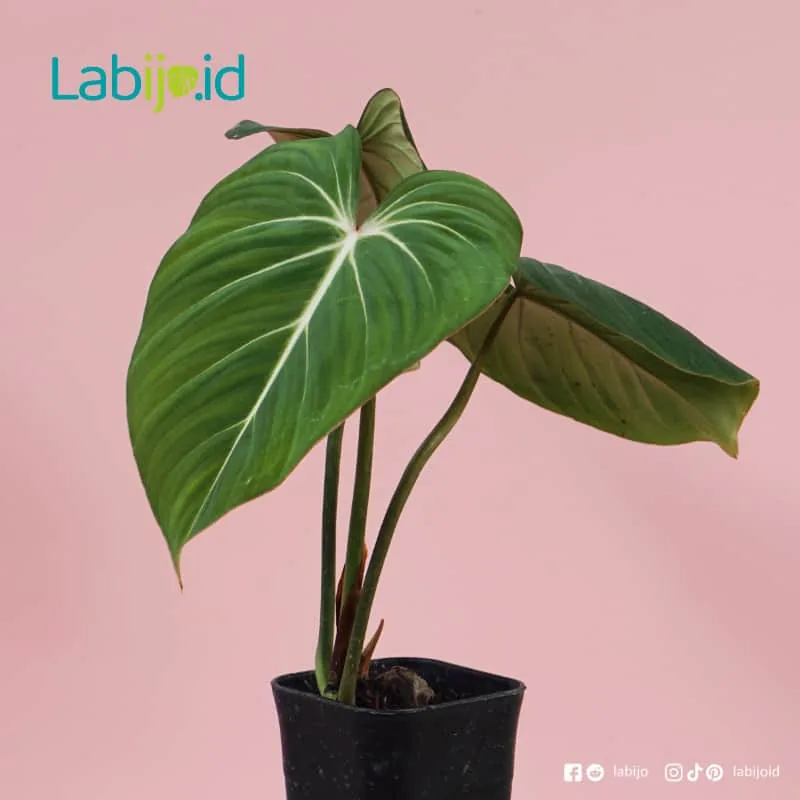
Gloriosum is the velvet Philodendron that looks most like a drawing. Round, almost circular blades carry a quilted surface with pale veins laid over it in a herringbone, held flat on short petioles so the leaf faces the light rather than the room. Collectors come for that shape and stay for the habit, because it does something the other velvet aroids do not: it walks. The stem creeps along the surface instead of climbing, and given a wide tray a mature plant spreads into a mat of overlapping leaves rather than a single crown.
Growing Philodendron gloriosum
- LightBright filtered lightBright filtered light keeps the markings crisp and the internodes short as the stem creeps. In deep shade the velvet dulls and the pale veins fade into the blade. Direct sun is worse than shade here: an hour of midday sun on a gloriosum leaf bleaches a patch that never recovers.
- WaterKeep the mix evenly moist while it is actively growingEven moisture, not wet compost. Water when the surface still feels cool and damp but the pot has stopped being heavy, and never let the mix dry until it pulls away from the sides. Because the stem runs across the surface, a dry spell desiccates the growing tip faster than it ever reaches the roots.
- Humidity60% – 80% relative humidity once acclimatisedThis is the one velvet Philodendron that wants the higher end, with 60% as the floor. The creeping stem and the newest leaf sit at the surface of the pot, in the stillest, most humid layer of air a room has, and that is exactly where dry air does its damage. A cabinet or a humidifier nearby solves it; misting the leaves does not.
- SubstrateChunky aroid mix — bark, perlite and coco coirChunky mix, but packed into a wide shallow pot rather than a deep one, because the stem travels horizontally and needs surface to travel over. Bark, perlite and coco coir in equal parts holds structure without staying saturated. Refresh the top layer each year; the mix under a creeping stem compacts faster than it does under an upright aroid.
- Temperature18 °C – 30 °CHold it between 18 °C and 30 °C, and mind the swing more than the number. The creeping stem sits close to the pot, where a cold windowsill chills it directly while a warm radiator dries the air above it. Steady warmth with moving air is what keeps the growing tip advancing through winter.
- PropagationStem cuttings — it roots from a node with a leaf on a creeping stemThe creeping stem roots from a node carrying a leaf, so a cutting is a section of stem with one leaf and a few centimetres either side of the node. Lay it on damp sphagnum, keep the node in contact with the moss, and cover it. Roots form in four to six weeks; never cut through an internode and expect a push.
Growth is horizontal and continuous. The tip advances a few centimetres a month in good conditions, throwing a leaf at each node and rooting as it goes, while the oldest leaves at the back of the mat yellow as the front moves on. That is normal rather than decline, and cutting the spent ones away keeps the plant moving. It flowers occasionally on a small white spadix that is easy to miss. What it will not tolerate is a deep pot: the stem needs surface, and a deep pot of wet mix rots the run.
Bare-root export and transit
Export is where a creeping species needs care in the packing rather than in the protocol. The stem is lifted whole, the substrate washed free, and the crown dipped in anti-fungal and bactericide solution before the roots are wrapped in sterile Chilean AAA damp sphagnum. Laid flat inside an EPS-insulated box in a corrugated carton, a bare-root gloriosum travels at 18 °C – 24 °C internal against 18 °C – 32 °C in the nursery at 70% – 85% RH, within the sealed climate box that covers 7 – 10 days. It re-roots from the node, not the cut.
How every consignment is prepared
- Root preparation100% Bare-root washed (zero soil, zero unsterilized peat).
- TreatmentSystemic broad-spectrum anti-fungal & bactericide dip treatment.
- Root wrapSterile Chilean AAA damp sphagnum moss protective root-envelope.
- Dispatch conditions to confirmConfirm root condition, packing method, route and arrival checks for Philodendron Gloriosum. Transit estimates are planning information; recovery depends on stock condition and the receiving environment.
Questions buyers ask
Why is my gloriosum growing out of the pot sideways?
That is the species rather than a fault. It creeps instead of climbing, and the stem will run over the rim and across the bench given the chance. Move it into a wide shallow tray and let the stem travel; training it upward stalls the growing tip.
Should I cut off the yellow leaves at the back?
Yes, once they are fully yellow. On a creeping plant the oldest leaves at the back of the mat go as the tip advances, and removing them frees surface without harming the plant. A leaf yellowing at the front is a different signal, usually mix that stays too wet.
Does it need a moss pole to grow well?
No, and it will not use one. Gloriosum is a ground creeper with no climbing instinct, so a pole stands unused while the stem runs the other way. Spend the space on a wide pot or a shallow tray, and give the stem room to root as it goes.
What the published literature calls this plant
A protologue is the original published description of a species. It helps you compare diagnostic characters — the features used to distinguish that species from similar plants. Compare those characters with photographs of the offered plant and its documented mother plant where available. A species description provides identification evidence; cultivation advice also needs evidence about growing conditions, as explained in the guidance above.
Philodendron gloriosum André · Araceae
The accepted name in the GBIF Backbone Taxonomy, the plant taxonomic backbone.
Protologue citation: Ill. Hort. 23: 194 (1876)
Recorded native range: CO; Parque Nacional Natural Tinigua.
Taxonomy from the GBIF Backbone Taxonomy. Open the backbone record.
Order Philodendron Gloriosum
Your plants arrive bare-root at export grade A+, washed free of substrate, with the roots wrapped in damp sphagnum and the whole plant packed in an insulated climate box. The minimum export order is 20 plants, volume discounts apply from 30 plants, and freight is quoted per volumetric box on the shipping page.
The commercial pages behind this guide
- How to import plants from IndonesiaThe full document-to-door sequence: bare-root preparation, Barantan certification, destination permits, inspection and arrival.
- Estimated shipping ratesFreight basis and indicative transit for a consignment, with the variables that move the price.
- Wholesale termsMinimum order, volume tiers, deposit, the document set, and the split of responsibility between exporter and importer.
- Live arrival guaranteeWhat the guarantee covers and how to report condition within the arrival window.