Philodendron atabapoense Care Guide
Philodendron Atabapoense — Araceae family, grown in our East Java nursery and shipped bare-root. Light, water, humidity, substrate, temperature, propagation and what happens to the plant in transit, in one place.
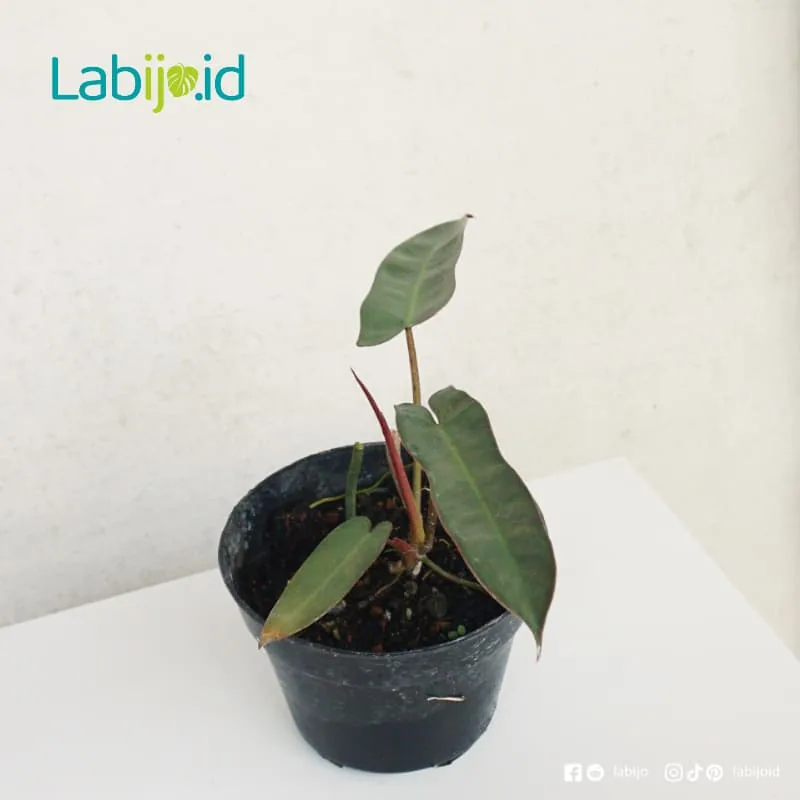
The dark, almost black-green blade is why this one sells. It opens bronze, settles into a velvet deep enough to read as fabric, and carries pale veins laid over the top like stitching. In growth the leaves are held on long petioles, so the plant reads as a crown of separate blades rather than a mass, each new leaf arriving at the centre and pushing the older ones outward. It climbs, and a moss pole changes its shape: leaves stay larger and closer together up the pole than they ever do on a bare windowsill.
Growing Philodendron atabapoense
- LightBright filtered lightAn east or west window, or a metre back from a south one, gives the brightness this species reads as filtered. In anything dimmer the internodes stretch and the leaves shrink. Direct midday sun bleaches the velvet within an afternoon and the bleached patch never darkens again.
- WaterLet the top third of the mix dry between wateringsThe top third drying is the whole signal; below that the mix should still read damp to the touch. Water thoroughly at the surface and let it drain away freely. A saucer left full keeps the root crown wet, which is the one condition this climber answers with yellow lower leaves and stalled growth.
- Humidity55% – 75% relative humidity once acclimatised55% is the floor rather than a target to chase. A room sitting in the sixties keeps new leaves unfurling cleanly; below that the emerging blade sticks and tears as it opens. Air movement counts as much as the number on the hygrometer, because still saturated air parks condensation on the velvet.
- SubstrateChunky aroid mix — bark, perlite and coco coirBark, perlite and coco coir in roughly equal parts drains fast while still holding enough body to carry moisture between waterings. Water should run through in seconds instead of pooling at the surface. Repot only when roots show at the drainage holes; a large pot of wet mix is the usual cause of decline.
- Temperature18 °C – 30 °C18 °C – 30 °C covers the growing season comfortably. Below 18 °C growth stops while the mix keeps holding water, and that combination is how root loss begins in winter. Keep the leaves off cold glass and out of the direct blast of a radiator; a plant this thin scorches in a day.
- PropagationSingle-node stem cuttings in damp sphagnumA single node carrying one leaf roots in damp sphagnum under a cover in three to five weeks. Take the cutting with a clean blade, let the cut callous for an hour, and keep the moss damp rather than wet. Water standing on a velvet leaf at this stage leaves a mark that stays.
The velvet is the entire difficulty. Water beads on that surface and leaves a mark that never fades, so the plant wants a narrow-spouted can aimed at the mix and nothing else, and it wants to be moved as little as possible. Growth is steady rather than quick: one leaf at a time, each held until the next is on its way. A mature plant in good conditions carries eight to twelve leaves; in a dim room it may hold four and simply wait. It forgives a missed watering and has no patience for being fussed over.
Bare-root export and transit
Bare-root transit suits this species better than it sounds. The plant is lifted, the substrate washed entirely free of the roots, and the crown dipped in anti-fungal and bactericide solution before wrapping — which is also the moment the velvet is most vulnerable, since a wet dip on a leaf is a permanent stain. Roots go into sterile Chilean AAA damp sphagnum, the plant into an EPS-insulated box inside a corrugated carton, and the sealed climate box holds 18 °C – 24 °C internally against 18 °C – 32 °C outside at 70% – 85% RH for the 7 – 10 day window a bare-root aroid can cross.
How every consignment is prepared
- Root preparation100% Bare-root washed (zero soil, zero unsterilized peat).
- TreatmentSystemic broad-spectrum anti-fungal & bactericide dip treatment.
- Root wrapSterile Chilean AAA damp sphagnum moss protective root-envelope.
- Dispatch conditions to confirmConfirm root condition, packing method, route and arrival checks for Philodendron Atabapoense. Transit estimates are planning information; recovery depends on stock condition and the receiving environment.
Questions buyers ask
Will the velvet leaves survive a bare-root flight?
They do, provided they stay dry. Roots travel wrapped in damp sphagnum and the crown is held away from the box walls, so moisture never reaches the leaf surface. On arrival, unwrap, check the velvet for damp patches, and pot into chunky mix without misting the foliage for the first week.
Why does my new leaf open bronze instead of black?
Every leaf on this species opens bronze to copper and darkens over two to three weeks as the velvet develops. That colour is the blade maturing, not a light or feeding problem. A leaf that stays pale and never deepens means the plant is sitting in light that is too dim.
Can I keep it on a shelf without a pole?
It will live, but the habit changes. Without something to climb the plant throws smaller leaves with longer gaps between them, and the crown flops outward as it gains weight. A moss pole or a coir plank against a wall keeps the leaves large and the plant upright.
What the published literature calls this plant
A protologue is the original published description of a species. It helps you compare diagnostic characters — the features used to distinguish that species from similar plants. Compare those characters with photographs of the offered plant and its documented mother plant where available. A species description provides identification evidence; cultivation advice also needs evidence about growing conditions, as explained in the guidance above.
Philodendron atabapoense G.S.Bunting · Araceae
The accepted name in the GBIF Backbone Taxonomy, the plant taxonomic backbone.
Protologue citation: Acta Bot. Venez. 10: 291 (1975)
Recorded native range: CO.
Taxonomy from the GBIF Backbone Taxonomy. Open the backbone record.
Order Philodendron Atabapoense
You receive bare-root plants at export grade A+, washed free of substrate, with the roots wrapped in damp sphagnum and the whole plant sealed in an insulated climate box. Minimum export order is 20 plants, volume discounts begin at 30 plants, and freight is quoted per volumetric box on the shipping page.
The commercial pages behind this guide
- How to import plants from IndonesiaThe full document-to-door sequence: bare-root preparation, Barantan certification, destination permits, inspection and arrival.
- Estimated shipping ratesFreight basis and indicative transit for a consignment, with the variables that move the price.
- Wholesale termsMinimum order, volume tiers, deposit, the document set, and the split of responsibility between exporter and importer.
- Live arrival guaranteeWhat the guarantee covers and how to report condition within the arrival window.