Hoya deykeae Care Guide
Hoya Deykeae — Apocynaceae family, grown in our East Java nursery and shipped bare-root. Light, water, humidity, substrate, temperature, propagation and what happens to the plant in transit, in one place.
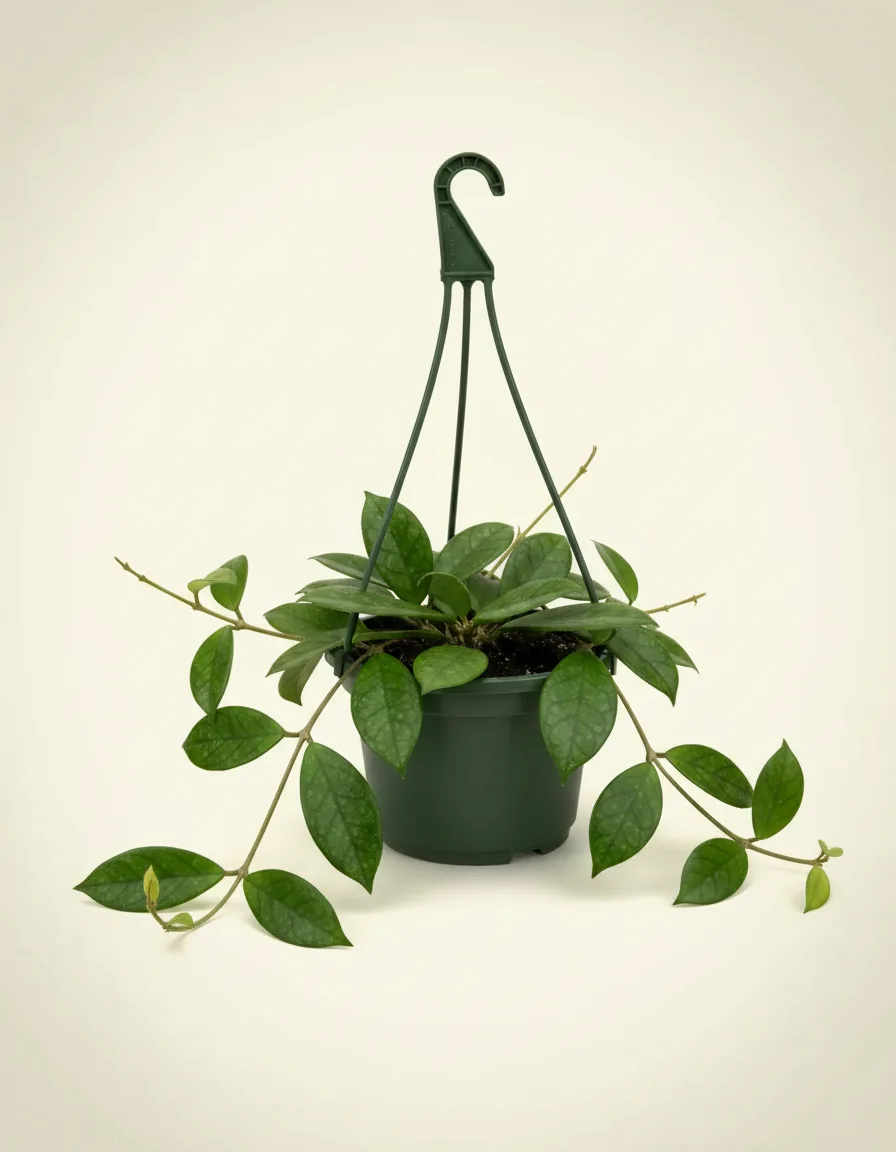
Hoya deykeae is collected for one reason: the splash. The leaves are small and set close on short internodes, and across them runs a scatter of silver that reads almost as a dusting until you tilt the leaf into the light. It is a compact plant rather than a rampant one, and a well-grown specimen stays dense and contained where Hoya amicabilis in the same pot would already be reaching for something to climb. That tight habit is what makes it collectible — a plant of this size holds its shape on a shelf and does not need cutting back twice a season to stay there.
Growing Hoya deykeae
- LightBright filtered lightGive it the brightest filtered position you can — an east window, or a metre back from a south glass. The silver splash is a light response, not a fixed marking: hold the plant in shade and new leaves come through plain green, and the older silvered leaves fade back toward it.
- WaterLet the potting mix dry to the top third between wateringsDry to the top third, then soak the pot until water runs clear from the base. In warm, bright growth the small pot reaches that point in days rather than weeks; in a dim winter room the interval lengthens. Check the mix before you water rather than working to a calendar.
- Humidity55% – 70% relative humidity once acclimatisedThe nursery runs 70% – 85% RH with air movement, and the plant settles into 55% – 70% once acclimatised. It is the air movement that matters as much as the number: a splash-leaved Hoya held in still, saturated air marks and spots. Ordinary room humidity is fine where air turns over.
- SubstrateChunky epiphytic mix — bark, perlite and coco coirBark, perlite and coco coir in roughly equal parts, with the bark screened to a medium grade rather than dust. The mix must stay open at the crown, because this species sits tight against its own stems and any pocket of wet mix at the node turns soft.
- Temperature18 °C – 30 °CKeep it between 18 °C and 30 °C, and hold it well clear of a radiator or a cold pane. Cooler nights in autumn are fine and are part of how the plant sets growth for the next season; a hot, dry draught across the leaves is the condition it answers with dropped buds.
- PropagationTwo-node stem cuttings in damp sphagnumTwo-node cuttings in damp sphagnum under cover, and this species is slower to callus than the faster Hoyas, so give it the full window before you check for roots. Pot up when the roots reach a few centimetres and keep the cutting in bright filtered light.
Habit is where this species asks for patience. Growth is slow and incremental, a node or two at a time, and a cutting that roots in spring is still a modest plant by the following winter. The trade-off is that it never runs away from its support and never needs a hard prune. What it does need is light: hold it in a dim position and the silver fades out of new growth within a couple of leaves, and the plant greens up into something that looks like a different clone. Restore the bright filtered position and the next leaves come back marked.
Bare-root export and transit
Export is straightforward for a plant this compact. The root mass is small and the stems short, so a bare-root division washes free of substrate without losing much, and the anti-fungal and bactericide dip is quick across a clean cut surface. Each plant is wrapped in sterile Chilean AAA damp sphagnum, packed into an EPS-insulated box inside a corrugated carton, and held between 18 °C and 24 °C for the transit. In that sealed box the plant holds condition for 7 – 10 days — long enough for most airfreight routings, and comfortable for a compact plant with a small root mass.
How every consignment is prepared
- Root preparation100% Bare-root washed (zero soil, zero unsterilized peat).
- TreatmentSystemic broad-spectrum anti-fungal & bactericide dip treatment.
- Root wrapSterile Chilean AAA damp sphagnum moss protective root-envelope.
- Dispatch conditions to confirmConfirm root condition, packing method, route and arrival checks for Hoya Deykeae. Transit estimates are planning information; recovery depends on stock condition and the receiving environment.
Questions buyers ask
Why has my Hoya deykeae gone plain green?
The silver is a light response. A plant held in shade pushes plain green leaves and fades on the older ones; move it to bright filtered light and the new growth comes through marked again. Nothing is wrong with the clone, and the change reverses over a few leaves.
How does Hoya deykeae arrive after shipping?
Bare-root, washed free of substrate, dipped against fungus and bacteria, and wrapped in sterile damp sphagnum. It travels in an EPS-insulated box inside a corrugated carton and holds condition for 7 – 10 days, then roots into a chunky epiphytic mix at home.
Why is Hoya deykeae slower than other Hoyas?
It is a tight, incremental grower rather than a rampant vine. A rooted cutting puts on a node or two at a time and takes a full season to look like a specimen, which is normal for the species. Give it bright filtered light and steady watering and it gets there without being pushed.
What the published literature calls this plant
A protologue is the original published description of a species. It helps you compare diagnostic characters — the features used to distinguish that species from similar plants. Compare those characters with photographs of the offered plant and its documented mother plant where available. A species description provides identification evidence; cultivation advice also needs evidence about growing conditions, as explained in the guidance above.
Hoya deykeae T.Green · Apocynaceae
The accepted name in the GBIF Backbone Taxonomy, the plant taxonomic backbone.
Protologue citation: Fraterna 13(1): 15. 2000 (as deykei)
Taxonomy from the GBIF Backbone Taxonomy. Open the backbone record.
Order Hoya Deykeae
Bare-root plants are graded A+ and ship in a sealed climate box with a 7 – 10 day transit window, wrapped in sterile damp sphagnum. The minimum export order is 20 plants, volume discounts begin at 30, and freight is quoted per volumetric box on the shipping page.
The commercial pages behind this guide
- How to import plants from IndonesiaThe full document-to-door sequence: bare-root preparation, Barantan certification, destination permits, inspection and arrival.
- Estimated shipping ratesFreight basis and indicative transit for a consignment, with the variables that move the price.
- Wholesale termsMinimum order, volume tiers, deposit, the document set, and the split of responsibility between exporter and importer.
- Live arrival guaranteeWhat the guarantee covers and how to report condition within the arrival window.