Hoya danumensis Care Guide
Hoya Danumensis — Apocynaceae family, grown in our East Java nursery and shipped bare-root. Light, water, humidity, substrate, temperature, propagation and what happens to the plant in transit, in one place.
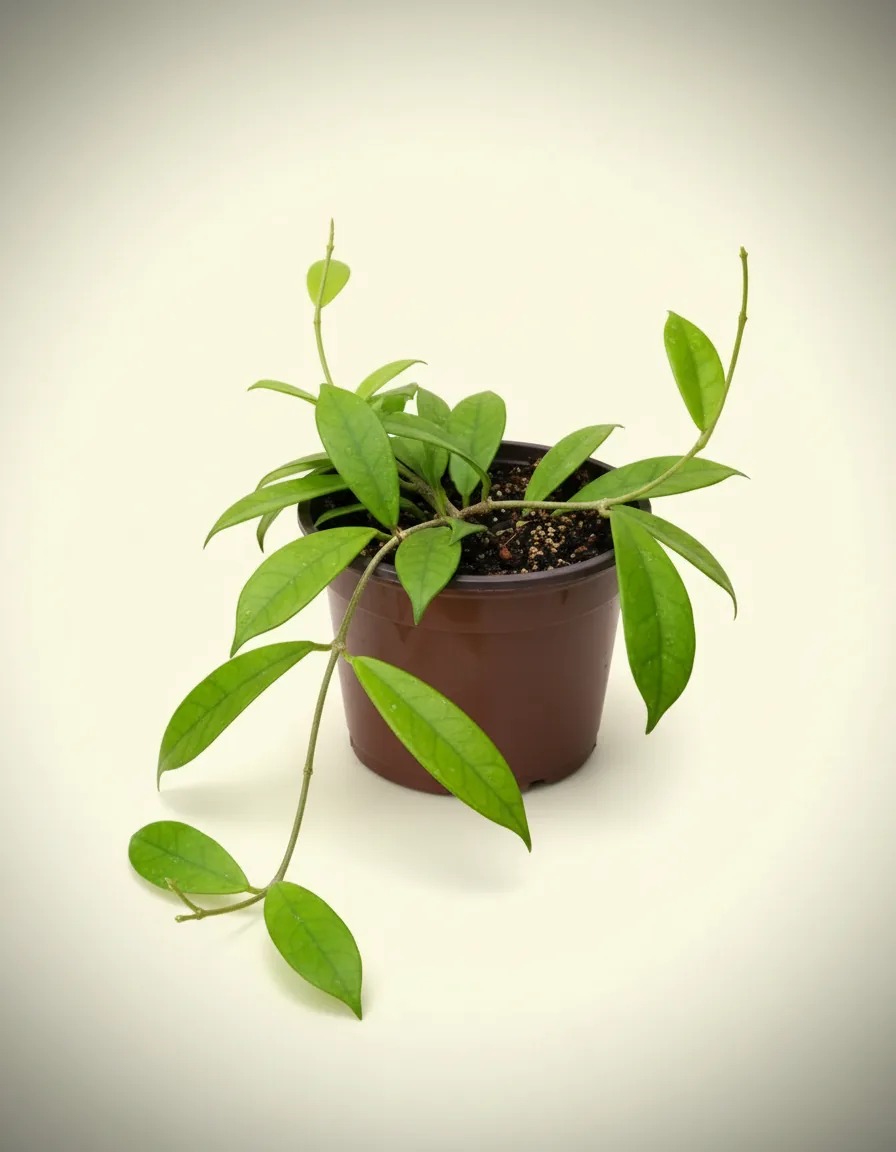
Hoya danumensis is the Hoya you buy when you want a frame covered. The leaves are small and spaced along a stem that moves, and the plant will take a wire hoop, a trellis or a moss pole without being tied into it. Compared with the compact, tight-growing species in the genus, this one is generous: cuttings lengthen within weeks and the growth is easy to direct. Collectors keep it for that vigour as much as for anything else, because a plant that fills a support makes the rest of a collection look settled rather than sparse.
Growing Hoya danumensis
- LightBright filtered lightBright filtered light, and plenty of it — this is a vine that builds length fast when the light is good. An east window or a spot a metre back from a south window suits it. Too little light gives you long, pale internodes and a plant that covers a frame loosely instead of densely.
- WaterLet the small pot dry almost completely between wateringsThis one wants the small pot to dry almost completely before the next watering, all the way down rather than just at the surface. In bright growth a small pot gets there quickly. A vine left standing wet at the base drops lower leaves and stretches pale toward the light instead of thickening.
- Humidity55% – 70% relative humidity once acclimatisedNursery air sits at 70% – 85% RH with movement, and the plant settles to 55% – 70% once acclimatised. A fast vine in dry air still grows but the leaf edges crisp and the growing tips stall; a room with a saucer of water nearby and a fan on low is usually enough.
- SubstrateFine chunky mix — coco coir, perlite and small barkCoco coir, perlite and small bark, screened fine, because the roots on this species are thin and a coarse mix leaves too much air around them at first. The mix should be light enough that a full watering drains through in seconds and the pot feels noticeably lighter the next day.
- Temperature18 °C – 30 °CHold it between 18 °C and 30 °C. The vine is actively growing for most of the year and does not want a cold spell in the middle of it; a windowsill that drops below 18 °C on winter nights will slow it to a standstill rather than damage it outright.
- PropagationTwo-node stem cuttings in damp sphagnumTwo-node cuttings in damp sphagnum are the reliable route, and because the vine grows fast, one mother plant yields cutting material all season. Pot a rooted cutting straight onto its support — this species takes hold of a frame quickly and covers it in a single growing season.
The flowers are small, star-shaped and strongly scented — that scent is the reason many growers keep the species at all, and it carries across a room in the evening. Buds form along the nodes of mature growth, and the plant is not fussy about how it gets there: steady light, a support to climb and a pot that dries between waterings are the whole of it. What it dislikes is being moved while it is in bud, and a vine that is turned or repotted at that point will drop them. Leave it where it is and the cluster opens over a couple of weeks.
Bare-root export and transit
Shipping is easy for a thin-stemmed vine. The plant is washed free of substrate, given the anti-fungal and bactericide dip, and wrapped in sterile Chilean AAA damp sphagnum; the root mass is small enough that the wrap holds it without bulk. It travels in an EPS-insulated box inside a corrugated carton, buffered between 18 °C and 24 °C, and holds condition for 7 – 10 days. The stems are flexible, so they pack around the box rather than against it, and a fast species like this one resumes growth quickly after bare-root transit.
How every consignment is prepared
- Root preparation100% Bare-root washed (zero soil, zero unsterilized peat).
- TreatmentSystemic broad-spectrum anti-fungal & bactericide dip treatment.
- Root wrapSterile Chilean AAA damp sphagnum moss protective root-envelope.
- Dispatch conditions to confirmConfirm root condition, packing method, route and arrival checks for Hoya Danumensis. Transit estimates are planning information; recovery depends on stock condition and the receiving environment.
Questions buyers ask
How quickly will Hoya danumensis cover a support?
Fast, by Hoya standards. Cuttings lengthen within weeks of rooting, and one plant will work its way around a wire hoop or a moss pole in a season. Give it bright filtered light and something to climb early, and it covers the frame rather than trailing past it.
How strongly scented are Hoya danumensis flowers?
Strongly, for a flower this small. The star-shaped blooms are carried along the nodes of mature growth and the scent reaches across a room in the evening. The plant dislikes being moved while in bud, so pick a position and leave it there.
Does Hoya danumensis ship well bare-root?
Yes. The stems are thin and the root mass small, so it packs into the sphagnum wrap with room to spare and holds condition for 7 – 10 days in the sealed climate box. It is one of the faster species to resume growth after transit.
What the published literature calls this plant
A protologue is the original published description of a species. It helps you compare diagnostic characters — the features used to distinguish that species from similar plants. Compare those characters with photographs of the offered plant and its documented mother plant where available. A species description provides identification evidence; cultivation advice also needs evidence about growing conditions, as explained in the guidance above.
Hoya danumensis Rodda & Nyhuus · Apocynaceae
The accepted name in the GBIF Backbone Taxonomy, the plant taxonomic backbone.
Protologue citation: Webbia 64: 164 (2009)
- Hoya danumensis , a new species of Hoya (Apocynaceae, Asclepiadoideae) from Borneo — Webbia (2009), the protologue
Taxonomy from the GBIF Backbone Taxonomy. Open the backbone record.
Order Hoya Danumensis
Bare-root plants are graded A+ and ship wrapped in sterile damp sphagnum, inside a sealed climate box with a 7 – 10 day transit window. The minimum export order is 20 plants, volume discounts begin at 30, and freight is quoted per volumetric box on the shipping page.
The commercial pages behind this guide
- How to import plants from IndonesiaThe full document-to-door sequence: bare-root preparation, Barantan certification, destination permits, inspection and arrival.
- Estimated shipping ratesFreight basis and indicative transit for a consignment, with the variables that move the price.
- Wholesale termsMinimum order, volume tiers, deposit, the document set, and the split of responsibility between exporter and importer.
- Live arrival guaranteeWhat the guarantee covers and how to report condition within the arrival window.