Dischidia major Care Guide
Dischidia Major — Apocynaceae family, exported from our East Java desk and shipped bare-root. Light, water, humidity, substrate, temperature, propagation and the dispatch details to confirm before transit, in one place.
What to know first
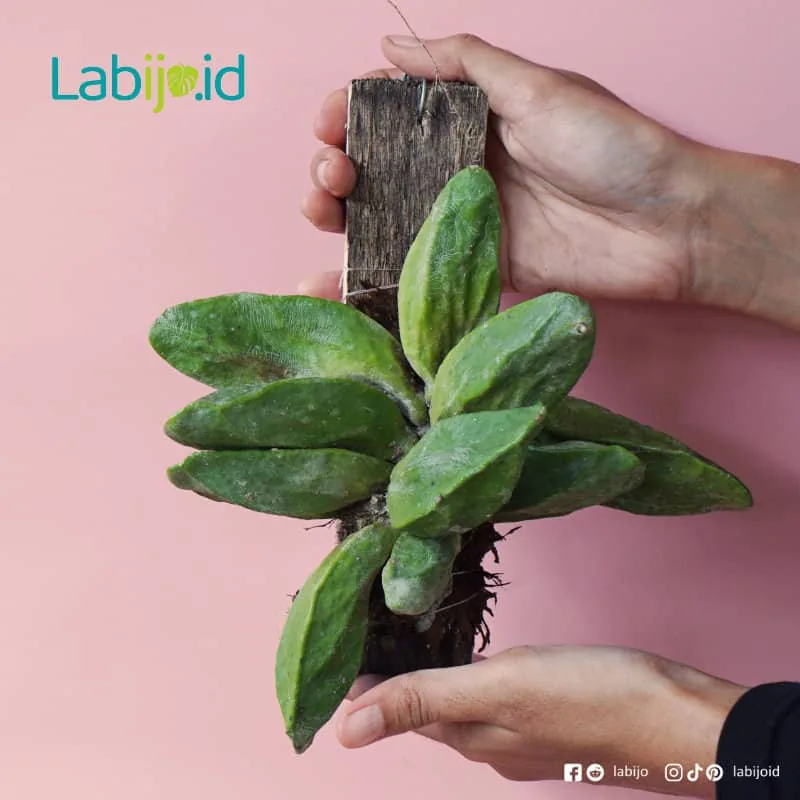
Dischidia major is a climbing epiphyte with two leaf forms: small, flat rounded leaves and much larger hollow pitcher leaves held against its support. Published field research documents roots branching inside the pitchers and ant-associated nutrient capture, but does not establish indoor care targets or transit tolerance.
- Flat leaves are about 2–3 × 1.5–2 cm; pitcher leaves are about 6–12 × 2–4 cm.
- Adventitious roots spread over the host and enter the pitcher cavities.
- Confirm the actual plant’s leaf forms, dimensions, stem length and rooting condition before ordering.
Rintz describes Dischidia major as a climbing epiphyte with two leaf forms. The ordinary leaves are flat and rounded, about 2–3 × 1.5–2 cm, while the modified pitcher leaves are about 6–12 × 2–4 cm, held against the host and deep purple inside. Adventitious roots spread over the host, and roots from pitcher-bearing nodes enter and branch through the hollow leaves. This combination is more useful for identification than a generic description of heart-shaped trailing foliage.
Growing Dischidia major
- LightGeneral epiphyte guidance: bright, filtered lightField records place this species in well-lit coastal and wet-tropical habitats, but they do not define an indoor light target. Use bright filtered light as general epiphyte guidance, observe the plant after arrival, and change exposure gradually.
- WaterGeneral epiphyte guidance: drain freely and avoid prolonged saturationThe botanical and ant-symbiosis studies do not test household watering schedules. Water according to the condition of the roots and growing medium, allowing drainage and avoiding a fixed full-dry rule that the available species research does not support.
- HumidityNo species-specific indoor humidity range is establishedDischidia major is recorded from wet-tropical habitats, including coastal forest, but habitat data cannot be converted into a precise room-humidity prescription. Provide airflow and monitor the actual plant instead of relying on an unsupported percentage range.
- SubstrateGeneral epiphyte guidance: an airy, freely draining supportIn nature this climbing epiphyte anchors to host surfaces with adventitious roots, including roots that enter its pitcher leaves. An airy support or freely draining epiphytic medium is a reasonable general starting point; the cited studies do not validate a particular bark, perlite or coir recipe.
- TemperatureWet-tropical species; no tested indoor temperature rangeKew records the species in the wet tropical biome across tropical Asia to northern Queensland. That supports describing it as tropical, but the reviewed literature does not establish minimum, maximum or preferred indoor temperatures.
- PropagationPropagation performance is not established by the reviewed studiesThe sources used here describe morphology, distribution and field symbiosis rather than propagation trials. Ask whether the offered plant is rooted and request a current root or base photo; no rooting method or timeline should be inferred from these papers.
Sources and growing guidance
- Rintz (1980), The Peninsular Malayan species of Dischidia
Field and herbarium treatment supporting morphology, two leaf forms, climbing epiphytic habit, regional distribution and habitat; it does not establish current stock condition or indoor care targets.
- Kew Plants of the World Online — Dischidia major (Vahl) Merr.
Current accepted name, climbing-epiphyte habit, wet-tropical biome and broad native distribution; it does not provide a tested cultivation protocol.
- Treseder, Davidson & Ehleringer (1995), Absorption of ant-provided carbon dioxide and nitrogen by a tropical epiphyte
Stable-isotope study of ant-associated nutrient acquisition at Bako National Park, Sarawak; its site-specific results do not establish indoor care or universal nutrient percentages.
- Peeters & Wiwatwitaya (2014), Philidris ants living inside Dischidia epiphytes from Thailand
Documents pitcher occupancy and nest structure in two Thai habitats, and shows that the studied Philidris association was not obligate for the ant; it does not test cultivation or transit.
Field studies document ants occupying the pitchers and depositing material around the internal roots. At Bako National Park in Sarawak, stable-isotope analysis found substantial carbon and nitrogen contributions associated with ants in the sampled plants. Research in two Thai habitats documented Philidris colonies and connected pitcher nests, while also finding Philidris nests away from the plant. These findings support an ecologically important association, not a claim that cultivated plants require ants.
Bare-root export and transit
The cited sources establish identity, natural growth habit, distribution and aspects of field symbiosis. They do not test indoor light levels, humidity percentages, watering intervals, potting recipes, propagation timelines or shipping survival. Care suggestions on this page are therefore labelled as general epiphyte guidance, and decisions after import should follow the condition of the actual roots, stems and leaves received.
How every consignment is prepared
- Root preparation100% Bare-root washed (zero soil, zero unsterilized peat).
- TreatmentSystemic broad-spectrum anti-fungal & bactericide dip treatment.
- Root wrapSterile Chilean AAA damp sphagnum moss protective root-envelope.
- Dispatch conditions to confirmNo reviewed source establishes a safe transit duration, temperature range or recovery period for Dischidia major. Before dispatch, confirm the actual plant’s rooting condition, measured stem length, leaf forms present, current photo and packing method.
Questions buyers ask
How can Dischidia major be identified by its leaves?
Look for two leaf forms on a climbing epiphyte: small flat, rounded leaves and much larger hollow, elongated pitcher leaves held against the support. Rintz reports the flat leaves at about 2–3 × 1.5–2 cm and the pitchers at about 6–12 × 2–4 cm.
Does Dischidia major need ants to grow?
Wild populations often house ants, and field research shows that occupied plants can obtain carbon and nitrogen associated with the ants. The studies do not show that ants are required for indoor cultivation, and they should not be treated as a household care requirement.
What should I confirm before ordering Dischidia major?
The catalog records Java and Sumatra origin and an A+ export grade, but it does not record current dimensions or rooting. Ask for a current photo and confirmation of the leaf forms present, measured stem length, rooting condition and how the actual plant will be packed.
What the published literature calls this plant
A protologue is the original published description of a species. It helps you compare diagnostic characters — the features used to distinguish that species from similar plants. Compare those characters with photographs of the offered plant and its documented mother plant where available. A species description provides identification evidence; cultivation advice also needs evidence about growing conditions, as explained in the guidance above.
Dischidia major (Vahl) Merr. · Apocynaceae
The accepted name in the GBIF Backbone Taxonomy, the plant taxonomic backbone.
Protologue citation: Merr. (1917). In: Interpr. Rumph. Herb. Amboin. 437.
- HOẠT TÍNH ỨC CHẾ XANTHINE OXIDASE VÀ KHÁNG UNG THƯ CỦA CAO CHIẾT DÂY MỎ QUẠ (Dischidia major (Vahl) Merr.) PHÚ QUỐC — Tạp chí Khoa học (2025)
- Crucial Role of Surfactants in Improving the Extraction Efficiency of β-Amyrin from Dischidia major Using Ultrasound-Assisted Extraction Coupled with Gas Bubble Flotation — Langmuir (2022)
- The symbiosis between Philidris ants and the ant-plant Dischidia major includes fungal and algal associates — Symbiosis (2021)
Taxonomy from the GBIF Backbone Taxonomy. Open the backbone record.
Order Dischidia Major
The product record lists Dischidia Major with Java and Sumatra origin, A+ export grade and phytosanitary-ready status. It does not specify dimensions, stem length, rooting condition or which leaf forms are present, so request those details and a current photo for the offered plant before adding it to a consignment.
The commercial pages behind this guide
- How to import plants from IndonesiaThe full document-to-door sequence: bare-root preparation, Barantan certification, destination permits, inspection and arrival.
- Estimated shipping ratesFreight basis and indicative transit for a consignment, with the variables that move the price.
- Wholesale termsMinimum order, volume tiers, deposit, the document set, and the split of responsibility between exporter and importer.
- Live arrival guaranteeWhat the guarantee covers and how to report condition within the arrival window.