Anthurium waroqueanum Care Guide
Anthurium Waroqueanum — Araceae family, grown in our East Java nursery and shipped bare-root. Light, water, humidity, substrate, temperature, propagation and what happens to the plant in transit, in one place.
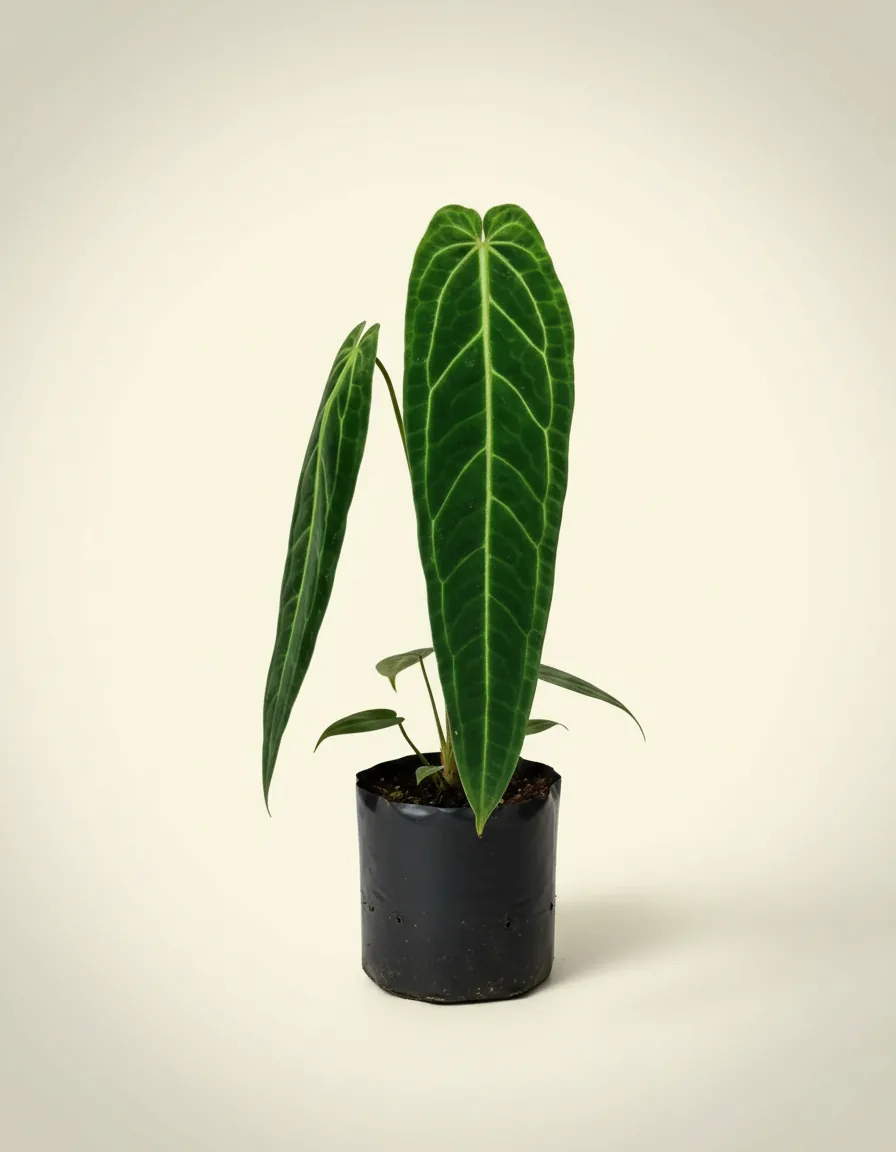
Waroqueanum is the queen anthurium, and it is priced accordingly. The blade is long, pendant and deeply impressed along the veins, so the surface reads as ribbed rather than flat, and a mature specimen carries leaves close to a metre. Collectors want it because no other anthurium quite reproduces that sculptural fold, and because it is slow: a plant at the size in the photographs has been grown well for years. In growth it is unmistakable — new blades emerge folded and unfurl over a week or more. Slowness is the point, not a fault.
Growing Anthurium waroqueanum
- LightBright indirect light with good air movementBright, diffused light with the plant sitting in moving air — a fan on low across the shelf is not excessive. It needs that light to keep the ribbed venation impressed, but a still, bright corner in summer is where it scorches, because heat builds on the blade faster than the leaf can shed it.
- WaterWater when the top 2 cm of the mix has driedWater when the top two centimetres have dried, and water the mix rather than the crown. The roots are thick, white and impatient with both extremes: a pot left dry for a week stalls the next leaf, and one that stays wet rots the base before the leaf shows it. Feel the weight of the pot before watering; a light pot is the honest signal.
- Humidity60% – 80% relative humidity once acclimatisedThis is the species that punishes dry air hardest. It settles at 60% – 80% RH after acclimatisation, from a nursery at 70% – 85%, and below 60% the newest leaf unfurls with a hard, brown edge that never softens. Humidity without air movement is not the answer — it wants both.
- SubstrateChunky aroid mix — bark, perlite and coco coirChunky aroid mix, bark-heavy, in a pot that drains within seconds of watering. The root system is small for the leaf area, so a big pot holds moisture the roots never reach; keep it snug and let the mix be an air supply rather than a reservoir. Repot only when the mix has broken down, and never into a pot more than one size up.
- Temperature18 °C – 28 °CHold 18 °C – 28 °C, with warmth and humidity together rather than either alone. It slows below 18 °C, and a cool, damp night is how this species loses roots; the ideal is a warm room with air moving, a harder combination to hold than either number on its own.
- PropagationSeed or division — a slow species, usually bought as an established plantDivision of a mature plant, or seed, and both are slow. Basal offsets are rare on a young specimen, which is why most plants in collections are bought established; a division needs warmth and humidity from the day it is cut. Take the offset in spring, with a full season of growth ahead of it.
It grows slowly and refuses to be hurried. One leaf at a time, hardening for a month, with the old blade yellowing only once the new one is nearly open; a plant that pushes two leaves in a season is doing well. What makes it fussy is the combination — warmth, humidity and air movement together, not any one of them. What makes it forgiving is that, once established in the right spot, it asks for nothing but consistency. The green, slender flowers take energy the plant would rather spend on the next leaf.
Bare-root export and transit
It is the species that most justifies the sealed box. Plants are washed free of substrate, dipped against fungus and bacteria, and the root mass wrapped in sterile Chilean AAA damp sphagnum; the long leaves are laid, not folded, and the whole plant is packed in an EPS-insulated box inside a corrugated carton. That internal 18 °C – 24 °C buffer holds against a ramp in full sun, and the plant keeps condition for 7 – 10 days. The nursery runs 70% – 85% RH at 18 °C – 32 °C, so the box is a smaller step than it sounds.
How every consignment is prepared
- Root preparation100% Bare-root washed (zero soil, zero unsterilized peat).
- TreatmentSystemic broad-spectrum anti-fungal & bactericide dip treatment.
- Root wrapSterile Chilean AAA damp sphagnum moss protective root-envelope.
- Dispatch conditions to confirmConfirm root condition, packing method, route and arrival checks for Anthurium Waroqueanum. Transit estimates are planning information; recovery depends on stock condition and the receiving environment.
Questions buyers ask
Why does my waroqueanum keep losing new leaves?
Usually a drop in humidity, or a cold night while the leaf was soft. The newest blade is the most exposed part of the plant and will abort if the room falls below 18 °C or the air dries out mid-unfurl. Hold warmth, 60% – 80% humidity and moving air together.
How big does Anthurium waroqueanum actually get?
Large, but slowly. Mature plants carry leaves approaching a metre on long petioles, on a stem that lengthens year by year. Expect a small plant to take several seasons to reach that size — this is not a species that fills a pot in one summer.
Is it normal for the old leaf to yellow when a new one opens?
Yes, and it is not a fault. The plant supports a limited number of leaves at once, so as the new blade hardens, the oldest is retired from the bottom of the stem. Cut it once it has gone fully yellow; removing it earlier makes the plant spend energy on a leaf it has already given up.
What the published literature calls this plant
A protologue is the original published description of a species. It helps you compare diagnostic characters — the features used to distinguish that species from similar plants. Compare those characters with photographs of the offered plant and its documented mother plant where available. A species description provides identification evidence; cultivation advice also needs evidence about growing conditions, as explained in the guidance above.
Anthurium warocqueanum T.Moore · Araceae
The accepted name in the GBIF Backbone Taxonomy, the plant taxonomic backbone.
Protologue citation: Florist & Pomol. 1878: 101 (1878)
Recorded native range: CO.
- ANTHURIUM WAROCQUEANUM — Curtis's Botanical Magazine (1995)
- TRANSMISSION AND SIGNIFICANCE OF B CHROMOSOMES IN ANTHURIUM WAROCQUEANUM — American Journal of Botany (1983)
- Karyotype and B chromosomes of Anthurium warocqueanum — Journal of Heredity (1979)
Taxonomy from the GBIF Backbone Taxonomy. Open the backbone record.
Order Anthurium Waroqueanum
You receive bare-root plants at export grade A+, washed free of substrate and wrapped in sterile damp sphagnum inside a sealed, insulated climate box. Minimum export order is 20 plants, volume discounts start at 30, and freight is quoted per volumetric box on the shipping page.
The commercial pages behind this guide
- How to import plants from IndonesiaThe full document-to-door sequence: bare-root preparation, Barantan certification, destination permits, inspection and arrival.
- Estimated shipping ratesFreight basis and indicative transit for a consignment, with the variables that move the price.
- Wholesale termsMinimum order, volume tiers, deposit, the document set, and the split of responsibility between exporter and importer.
- Live arrival guaranteeWhat the guarantee covers and how to report condition within the arrival window.