Anthurium papillilaminum Care Guide
Anthurium Papillilaminum — Araceae family, grown in our East Java nursery and shipped bare-root. Light, water, humidity, substrate, temperature, propagation and what happens to the plant in transit, in one place.
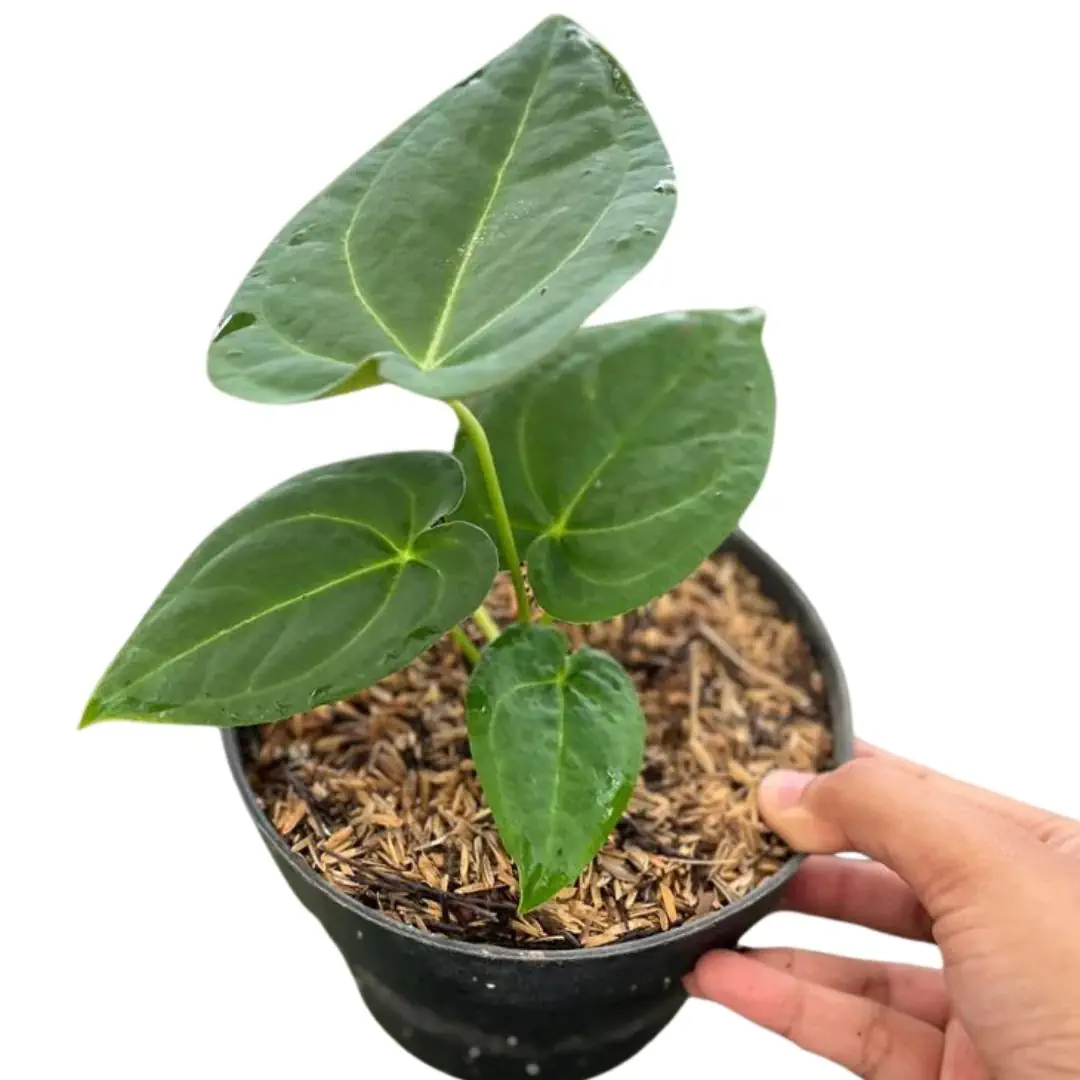
Papillilaminum is wanted for the surface of the leaf rather than the shape of the plant. The blade is dark green and quilted deeply enough that water beads and sits in the folds, and the texture runs from the midrib all the way to the margin, so a well-grown plant reads as corrugated rather than flat. It stays compact — the rosette tightens instead of stretching — which is why a collector with a shelf and a lamp can grow it well, and why a plant held in dim light too long shows the folds softening rather than the leaf enlarging.
Growing Anthurium papillilaminum
- LightLow to moderate light — deep quilted leaves scorch in direct sunA north-facing window, or a spot two metres back from a south window, suits it — this is the one velvet anthurium that keeps its colour in shade. Direct sun on the folds bleaches the blade within days and the scorch does not heal, so a bright room with the pot set back from the glass is the safer mistake.
- WaterKeep the mix evenly moist, never waterloggedThe mix should feel damp at the surface but never sit in a saucer of water. Water when the top centimetre reads dry, and drop to a light weekly pass in a cool room, because a cold, saturated pot is how this species loses roots. In summer, check twice a week rather than watering on a fixed day.
- Humidity60% – 80% relative humidity once acclimatisedThe nursery holds this species at 70% – 85% RH, and it hardens to 60% – 80% once acclimatised. Below that the leaf edges crisp before the next blade unfolds. A tray of water beside the pot or a grouped shelf closes the gap, since moving air matters as much as the number; a sealed cloche raises the reading and stalls the plant instead.
- SubstrateChunky aroid mix — bark, perlite and coco coirBark, perlite and coco coir in roughly equal parts, with the bark pieces large enough to see. The root mass on a compact plant is small, so a pot barely wider than the crown dries evenly; a large pot of the same mix keeps the lower half wet for weeks. Repot in spring, and only when the roots are circling the drainage holes.
- Temperature18 °C – 28 °CHold 18 °C – 28 °C and keep the plant off cold glass. It takes a warm room and a slow winter better than the broader velvet anthuriums, but a night below 15 °C on a windowsill will mark the newest leaf before it hardens. It dislikes a sudden move between a warm room and a cool one more than either temperature on its own.
- PropagationSeed or division at the base of a mature plantDivision is the practical route, since a mature clump throws basal offsets that separate with roots of their own. Seed is possible but slow, and a plant raised from seed takes years to reach the quilted leaf that makes the species worth having. Take the offset with a clean blade and keep it warm and humid until the first new root shows.
There is no dramatic seasonal move with this species: it pushes one leaf at a time, and each new blade hardens over three or four weeks before the next emerges. What makes it forgiving is the light range — it holds colour in a corner where the crystallinum and the waroqueanum sulk — and what makes it fussy is water at the crown. The petioles sit close together on a compact rosette, so water poured into the centre has nowhere to go. Water the mix at the edge of the pot, keep air moving, and the next leaf will unfold fully rather than stall half-open.
Bare-root export and transit
In transit it is one of the sturdier aroids. The plant is lifted, washed free of substrate, dipped in an anti-fungal and bactericide solution, and its roots are wrapped in sterile Chilean AAA damp sphagnum before the whole plant goes into an EPS-insulated box inside a corrugated carton. That sealed box holds an internal 18 °C – 24 °C buffer against ramp heat and hold cold, and the plant keeps its condition across a 7 – 10 day window; the nursery behind it runs 70% – 85% RH at 18 °C – 32 °C, so the box is a step down rather than a shock.
How every consignment is prepared
- Root preparation100% Bare-root washed (zero soil, zero unsterilized peat).
- TreatmentSystemic broad-spectrum anti-fungal & bactericide dip treatment.
- Root wrapSterile Chilean AAA damp sphagnum moss protective root-envelope.
- Dispatch conditions to confirmConfirm root condition, packing method, route and arrival checks for Anthurium Papillilaminum. Transit estimates are planning information; recovery depends on stock condition and the receiving environment.
Questions buyers ask
How much light does Anthurium papillilaminum actually need?
Less than its relatives. A north window, or two metres back from a south-facing one, keeps the quilted colour without bleaching it. If the folds are flattening and the petioles are stretching, the plant is asking for more light; if the leaves are pale and scorched at the margin, it is getting too much.
Why does the centre of my papillilaminum rosette rot?
Water is reaching the crown and staying there. The petioles sit tight on a compact rosette, so pour at the edge of the pot and let the mix draw the moisture sideways. Keep the mix evenly moist rather than soaked, and give the plant air movement — a stagnant pocket around the crown is what kills it.
Does it ship bare-root, and how long does it take to settle?
Yes. Plants leave the nursery washed free of substrate, dipped and wrapped in sterile damp sphagnum inside an insulated box, and hold condition for 7 – 10 days in transit. Pot into a chunky aroid mix on arrival and keep it warm and shaded for the first two weeks while the roots re-establish.
What the published literature calls this plant
A protologue is the original published description of a species. It helps you compare diagnostic characters — the features used to distinguish that species from similar plants. Compare those characters with photographs of the offered plant and its documented mother plant where available. A species description provides identification evidence; cultivation advice also needs evidence about growing conditions, as explained in the guidance above.
Anthurium papillilaminum Croat · Araceae
The accepted name in the GBIF Backbone Taxonomy, the plant taxonomic backbone.
Protologue citation: Monogr. Syst. Bot. Missouri Bot. Gard. 14: 152 (1986)
Taxonomy from the GBIF Backbone Taxonomy. Open the backbone record.
Order Anthurium Papillilaminum
You receive export-grade A+ bare-root plants, washed free of substrate and wrapped in sterile damp sphagnum inside an insulated, sealed climate box. The minimum export order is 20 plants, volume discounts start at 30, and freight is quoted per volumetric box on the shipping page.
The commercial pages behind this guide
- How to import plants from IndonesiaThe full document-to-door sequence: bare-root preparation, Barantan certification, destination permits, inspection and arrival.
- Estimated shipping ratesFreight basis and indicative transit for a consignment, with the variables that move the price.
- Wholesale termsMinimum order, volume tiers, deposit, the document set, and the split of responsibility between exporter and importer.
- Live arrival guaranteeWhat the guarantee covers and how to report condition within the arrival window.