Anthurium crystallinum Care Guide
Anthurium Crystallinum Dark Form — Araceae family, grown in our East Java nursery and shipped bare-root. Light, water, humidity, substrate, temperature, propagation and what happens to the plant in transit, in one place.
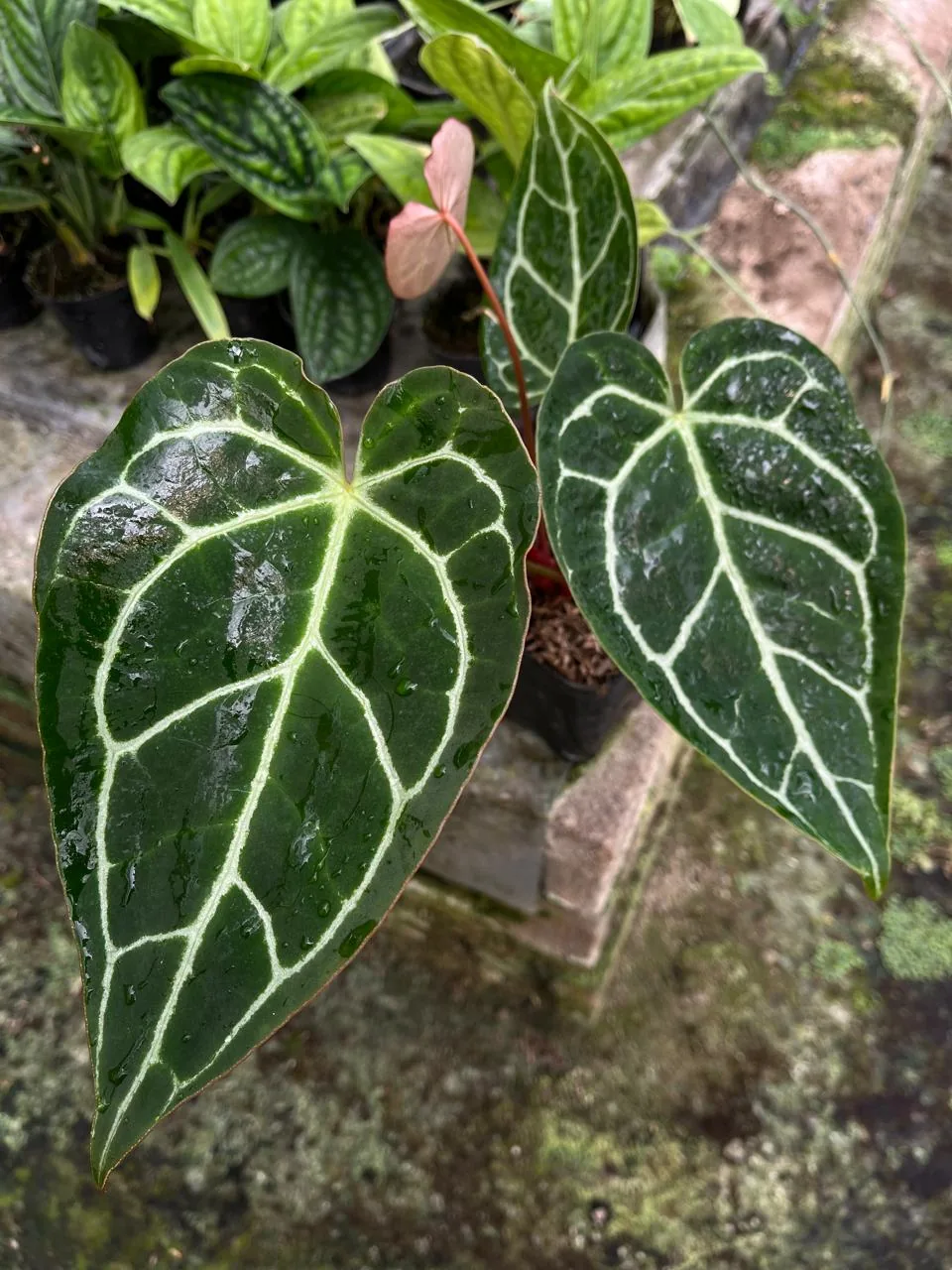
The dark form is bought for contrast: pale silver veins laid over a blade so deep green it reads as near-black in shade, with a velvet surface that scatters light instead of reflecting it. The leaf emerges bronze-red and hardens to that colour over roughly three weeks, so a plant in active growth carries two tones at once. Collectors pay for the form because the venation is wider and more sharply defined than the ordinary crystallinum, and because the leaf holds that definition as it ages rather than silvering over.
Growing Anthurium crystallinum
- LightBright indirect light, no direct sun on the leavesAn east window is the simplest fit: strong morning light and nothing harsh after ten. The silver venation deepens with brightness, but one hour of direct afternoon sun on a velvet blade leaves a bleached patch that never darkens again, so keep a sheer curtain against south or west glass. A sheer and half a metre of distance are enough.
- WaterWater when the top 2 cm of the mix has driedTwo centimetres of dry mix is the trigger, and in a warm room that is roughly weekly. Water the surface evenly and let it drain through rather than sipping at it; the velvet leaf marks permanently where water sits, so water the mix and leave the blade dry. In winter the same test applies and the interval doubles.
- Humidity60% – 80% relative humidity once acclimatisedIt hardens to 60% – 80% RH after acclimatisation, from a nursery held at 70% – 85%. The velvet surface resists water but not dry air: below 60% the new leaf emerges with a creased, pinched margin, and once that blade hardens the crease stays. Grouping pots or a pebble tray closes the gap without wetting the leaf.
- SubstrateChunky aroid mix — bark, perlite and coco coirBark, perlite and coco coir in equal parts, in a pot a finger can push into. The roots are thick and want air as much as moisture, so the mix matters more than the schedule; a fine, peaty blend compacts around them within a season and the plant stalls. Refresh the top layer yearly rather than repotting a settled plant.
- Temperature18 °C – 28 °C18 °C – 28 °C is the settled range, and steadiness matters more than warmth. A plant moved from a warm room to a cold windowsill drops its oldest leaf within a week; the dark form holds colour best where the night does not fall below 18 °C.
- PropagationSeed or division — offsets separate at the base once the plant is establishedOffsets appear at the base once the plant carries several leaves, and they separate cleanly with a knife and roots of their own. Seed is viable but slow — a seedling takes years to show the venation pattern that makes the dark form worth the price. Lift an offset with its own roots and do not bury the base of the stem.
Growth is a slow rosette — one leaf, then a pause while it hardens, then the next, with the older blades yellowing as the stem lengthens. The species is forgiving about water and fussy about the leaf surface: it will forgive a missed watering and will not forgive a splash. Flowering is unremarkable and not the reason to grow it; the spathe appears through the warm months and can be cut without harm. What the plant demands is brightness without sun, and air that moves — a plant never allowed to dry slightly at the surface pushes soft leaves that tear at the petiole.
Bare-root export and transit
It travels better than its reputation suggests. The plant is washed free of substrate, dipped against fungus and bacteria, and the roots wrapped in sterile Chilean AAA damp sphagnum before packing in an EPS-insulated box inside a corrugated carton. That sealed box holds an internal 18 °C – 24 °C buffer and keeps condition for 7 – 10 days, while the nursery behind it runs 70% – 85% RH at 18 °C – 32 °C. The velvet blade is the fragile part, and the wrap keeps it off the carton wall.
How every consignment is prepared
- Root preparation100% Bare-root washed (zero soil, zero unsterilized peat).
- TreatmentSystemic broad-spectrum anti-fungal & bactericide dip treatment.
- Root wrapSterile Chilean AAA damp sphagnum moss protective root-envelope.
- Dispatch conditions to confirmConfirm root condition, packing method, route and arrival checks for Anthurium Crystallinum Dark Form. Transit estimates are planning information; recovery depends on stock condition and the receiving environment.
Questions buyers ask
Why are the leaves on my crystallinum dark form going pale?
Usually too much light. The silver venation should sit on a dark blade; when the whole leaf washes out, the plant is getting direct sun or sitting too close to a grow lamp. Move it back from the glass, and note that a bleached patch will not green up again.
Can I mist the velvet leaves?
Better not. Water sitting on the velvet marks the blade and invites leaf spot, and the plant gets nothing from a misting that evaporates in minutes. Raise humidity around the pot instead — a grouped shelf, a pebble tray or a room humidifier — and keep water off the leaf entirely.
How long until a bare-root plant settles?
Expect two to three weeks. Pot it into a chunky aroid mix, keep it warm and out of direct light, and water sparingly until a new leaf starts to move. Plants hold 7 – 10 days in the sealed transit box, so they arrive with roots intact but thirsty.
What the published literature calls this plant
A protologue is the original published description of a species. It helps you compare diagnostic characters — the features used to distinguish that species from similar plants. Compare those characters with photographs of the offered plant and its documented mother plant where available. A species description provides identification evidence; cultivation advice also needs evidence about growing conditions, as explained in the guidance above.
Anthurium crystallinum Linden & André · Araceae
The accepted name in the GBIF Backbone Taxonomy, the plant taxonomic backbone.
Protologue citation: Cat. Gén. 90: t. 128 (1873)
Recorded native range: CO.
- NGHIÊN CỨU NHÂN GIỐNG IN VITRO CÂY HỒNG MÔN crystallinum (Anthurium crystallinum) — TẠP CHÍ KHOA HỌC LÂM NGHIỆP (2025)
- Perbanyakan Anthurium crystallinum pada Media Mengandung BAP dan IAA secara in Vitro — Jurnal Hortikultura Indonesia (2024)
- Persepsi dan Preferensi Konsumen Terhadap Tanaman Hias Kuping Gajah (Anthurium crystallinum) di Kota Bogor — Karimah Tauhid (2024)
Taxonomy from the GBIF Backbone Taxonomy. Open the backbone record.
Order Anthurium Crystallinum Dark Form
Plants ship bare-root at export grade A+, washed free of substrate and wrapped in sterile damp sphagnum inside an insulated, sealed climate box. Minimum export order is 20 plants; volume discounts begin at 30, and freight is quoted per volumetric box on the shipping page.
The commercial pages behind this guide
- How to import plants from IndonesiaThe full document-to-door sequence: bare-root preparation, Barantan certification, destination permits, inspection and arrival.
- Estimated shipping ratesFreight basis and indicative transit for a consignment, with the variables that move the price.
- Wholesale termsMinimum order, volume tiers, deposit, the document set, and the split of responsibility between exporter and importer.
- Live arrival guaranteeWhat the guarantee covers and how to report condition within the arrival window.