Rhaphidophora megasperma Care Guide
Rhaphidophora Megasperma — Araceae family, grown in our East Java nursery and shipped bare-root. Light, water, humidity, substrate, temperature, propagation and what happens to the plant in transit, in one place.
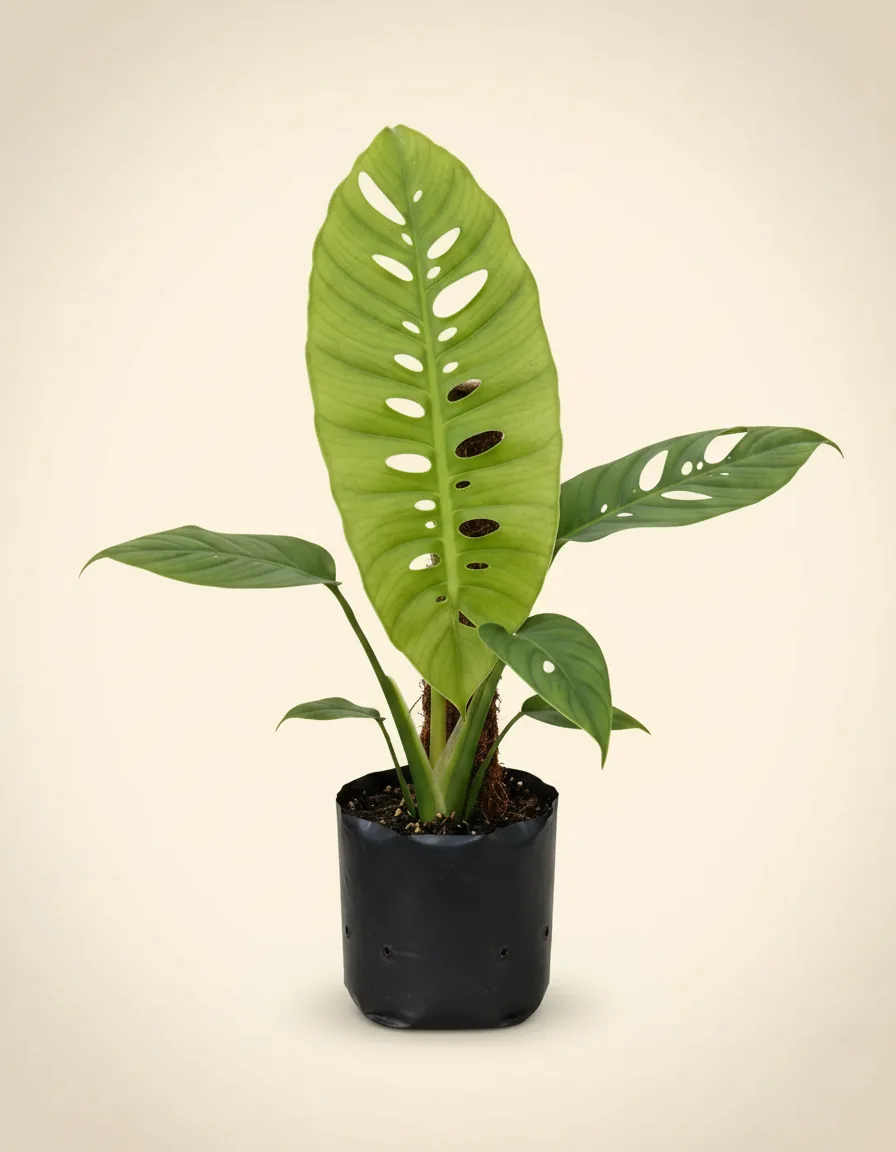
Rhaphidophora megasperma is sold under a wrong name more often than most aroids in this catalogue, and collectors buy it because of the leaves rather than the label. The blade is broad and heart-shaped, glossy once it hardens off, and it emerges at a size that reads mature from the first unfurl on an established plant. The stem is the real show: thick, fast, and studded with aerial roots that grip a pole in weeks. In growth, a single plant can cover a metre of support in one warm season, which is why it is bought as a climbing specimen rather than a shelf plant.
Growing Rhaphidophora megasperma
- LightBright filtered lightAn east window, or a metre back from a south one, gives the broad blade the light it needs without bleaching it. Under weaker light the internodes stretch and the leaf size drops on each successive node, which is the first sign it wants more.
- WaterLet the top third of the mix dry between wateringsDry the top third, then soak the pot until water runs clear from the base. This species climbs fast enough to empty a pot in a week of warm weather, so check by weight rather than by calendar. Soggy mix at the aerial roots is the one mistake it does not forgive.
- Humidity55% – 75% relative humidity once acclimatisedHold it at 55% – 75% once it has settled, which is ordinary living-room air in most temperate homes. The aerial roots it throws along the stem grip a moss pole far better in the upper half of that band, and crisped leaf edges are the signal that the room has dropped too dry.
- SubstrateChunky aroid mix — bark, perlite and coco coirBark, perlite and coco coir in roughly equal parts, with the bark graded coarse rather than fine. The mix has to carry a heavy climbing stem and a dense aerial-root mat, so it needs structure as much as drainage. Repot when the roots circle the surface, not on a fixed schedule.
- Temperature18 °C – 30 °CKeep it between 18 °C and 30 °C, and away from a sill that drops cold overnight. Warmth drives the climb: a plant held at the lower end of the band advances a node every few weeks, while one held near 28 °C moves visibly in the same period.
- PropagationStem cuttings with a node and an aerial rootTake a cutting with a node and at least one aerial root, and set it into damp sphagnum or straight into the chunky mix. Aerial roots root almost immediately when they touch moisture, which makes this one of the faster aroids to multiply from a single stem.
It behaves like a philodendron but belongs to a separate genus, and the difference shows in the climb: it ascends faster than most aroids of comparable leaf size and throws roots from every node as it goes. Given a pole or a plank it shingles; left to trail, it produces smaller leaves with longer gaps between them. It is forgiving about water and about light, and unforgiving about one thing only — a potting mix that stays wet at the base. Warmth through winter keeps it moving; a cool, dim room simply pauses it, and it resumes from the last node when conditions improve.
Bare-root export and transit
Export is bare-root, and this species carries it well because the aerial roots travel without a substrate to hold them. The plant is lifted, washed free of every trace of mix, dipped in an anti-fungal and bactericide solution, and the root mass is wrapped in sterile Chilean AAA damp sphagnum. It then travels inside an EPS-insulated box within a corrugated carton, which holds an internal temperature in an 18 °C – 24 °C buffer and humidity between 70% and 85% for the 7 – 10 day sealed window. What arrives is a section of thick stem carrying nodes and aerial roots; pot it into chunky mix at the depth it grew and keep it warm.
How every consignment is prepared
- Root preparation100% Bare-root washed (zero soil, zero unsterilized peat).
- TreatmentSystemic broad-spectrum anti-fungal & bactericide dip treatment.
- Root wrapSterile Chilean AAA damp sphagnum moss protective root-envelope.
- Dispatch conditions to confirmConfirm root condition, packing method, route and arrival checks for Rhaphidophora Megasperma. Transit estimates are planning information; recovery depends on stock condition and the receiving environment.
Questions buyers ask
Is Rhaphidophora megasperma a philodendron?
No. It is a separate genus, though the heart-shaped blade and climbing habit invite the comparison. The distinguishing traits are the girth of the aerial roots and the speed of the climb; it ascends faster than most aroids carrying leaves of the same width.
Will the roots survive export as a bare-root plant?
They travel well. The plant ships washed free of substrate and wrapped in sterile damp sphagnum inside a sealed, insulated box with a 7 – 10 day window. The aerial roots along the stem carry it through: cut nothing on arrival, pot into chunky mix and water once.
Does it need a moss pole to reach full leaf size?
In practice, yes. Given a support the stem shingles against it and the nodes it produces carry the larger blades; left to trail from a pot the plant keeps growing, but the leaves stay smaller with longer gaps between them.
What the published literature calls this plant
A protologue is the original published description of a species. It helps you compare diagnostic characters — the features used to distinguish that species from similar plants. Compare those characters with photographs of the offered plant and its documented mother plant where available. A species description provides identification evidence; cultivation advice also needs evidence about growing conditions, as explained in the guidance above.
Rhaphidophora megasperma Engl. · Araceae
The accepted name in the GBIF Backbone Taxonomy, the plant taxonomic backbone.
Protologue citation: Bot. Jahrb. Syst. 25: 8 (1898)
Taxonomy from the GBIF Backbone Taxonomy. Open the backbone record.
Order Rhaphidophora Megasperma
Each plant is supplied bare-root, washed free of substrate and graded A+, wrapped in sterile damp sphagnum inside a sealed, insulated box with a 7 – 10 day transit window. The minimum export order is 20 plants, volume discounts begin at 30, and freight is quoted per volumetric box on the shipping page.
The commercial pages behind this guide
- How to import plants from IndonesiaThe full document-to-door sequence: bare-root preparation, Barantan certification, destination permits, inspection and arrival.
- Estimated shipping ratesFreight basis and indicative transit for a consignment, with the variables that move the price.
- Wholesale termsMinimum order, volume tiers, deposit, the document set, and the split of responsibility between exporter and importer.
- Live arrival guaranteeWhat the guarantee covers and how to report condition within the arrival window.