Monstera peru Care Guide
Monstera Peru Variegata — Araceae family, grown in our East Java nursery and shipped bare-root. Light, water, humidity, substrate, temperature, propagation and what happens to the plant in transit, in one place.
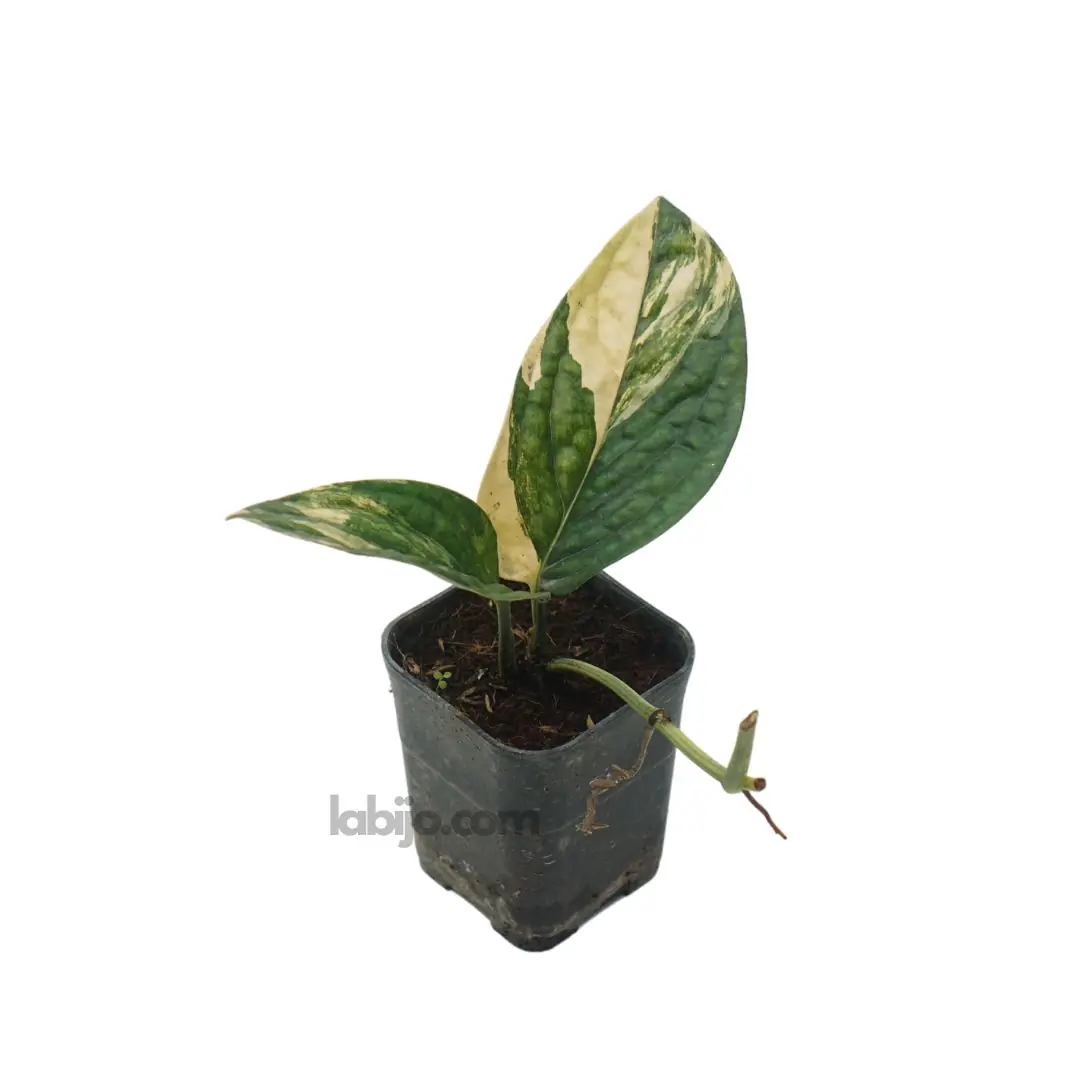
Cream-marbled, narrow and elongated: the Peru leaf is already a long oval with a ribbed surface, and variegation turns it into something collectors photograph against a dark wall. The marbling runs in streaks from the midrib outward rather than in blocky sectors, so no two leaves match. That is the appeal and the warning in one — the pattern is unstable, and a plant that produces a fully green leaf has not reverted, it has simply grown one. That instability is the open secret of the trade, and it is what keeps a heavily marbled specimen worth hunting.
Growing Monstera peru
- LightBright filtered lightBright filtered light is what holds the cream marbling. A variegated leaf carries less chlorophyll, so the plant needs more light than the plain Peru form to grow at the same rate, yet direct sun scorches the pale sections first because they have no pigment to protect them. East light is the balance.
- WaterLet the top third of the mix dry between wateringsLet the top third dry, then water through. The cream sections transpire less than the green ones, so this plant uses water a little slower than the plain form and is easier to overwater. The weight of the pot is the honest signal: lift it before watering, and skip the can if it still feels heavy.
- Humidity55% – 75% relative humidity once acclimatised55% is enough once it has settled, and this one hardens off to room humidity more readily than most velvet aroids. Hold 60% – 70% while a new leaf is unfurling and it opens without sticking. Very high humidity without air movement does the variegated sections more harm than dry air does.
- SubstrateChunky aroid mix — bark, perlite and coco coirBark, perlite and coco coir, in a pot only one size up. The roots are vigorous but thin, and they colonise a small pot quickly before the mix has a chance to sour. Drainage holes matter more than pot material; a decorative pot without them will hold water against the base of the stem.
- Temperature18 °C – 30 °C18 °C – 30 °C suits it, and variegation makes cold more damaging than it is on the green form: pale tissue browns at the edges after one night against cold glass. Keep it off a windowsill below 18 °C in winter and away from direct radiator heat, which desiccates the cream sections fastest of all.
- PropagationStem cuttings with a node and an aerial rootA stem cutting with a node and an aerial root is the reliable unit, because that aerial root is what makes rooting fast and low-risk. Cut below the node, keep the aerial root intact, and lay it into damp sphagnum so the root tip is buried and the node sits on the surface. Roots in three to five weeks.
Growth is a climbing vine with thick aerial roots and a new leaf every few weeks in season, each larger than the last while the plant has something to hold. Left to trail, the leaves shrink and the stem runs along the bench. Flowering in a room is rare and not the point. The fussy part is the variegation: pale sections burn, brown at the edges in dry heat, and slow the whole plant down because they feed nothing. The forgiving part is the root system, tough enough to survive a missed watering and a repot in the same month.
Bare-root export and transit
Bare-root transit is straightforward for a plant with roots this cooperative. Substrate is washed completely from the root mass, the crown goes through an anti-fungal and bactericide dip, and the roots — aerial roots included — are wrapped in sterile Chilean AAA damp sphagnum. The plant travels in an EPS-insulated box inside a corrugated carton at 18 °C – 24 °C internal, against 18 °C – 32 °C in the nursery and 70% – 85% RH. The sealed climate box is rated for 7 – 10 days, and the aerial roots travel in the same damp moss as the rest.
How every consignment is prepared
- Root preparation100% Bare-root washed (zero soil, zero unsterilized peat).
- TreatmentSystemic broad-spectrum anti-fungal & bactericide dip treatment.
- Root wrapSterile Chilean AAA damp sphagnum moss protective root-envelope.
- Dispatch conditions to confirmConfirm root condition, packing method, route and arrival checks for Monstera Peru Variegata. Transit estimates are planning information; recovery depends on stock condition and the receiving environment.
Questions buyers ask
Will the cream sections survive shipping?
Yes. Pale tissue is the most fragile part of the plant, which is why it is packed inside insulation rather than against a carton wall. Check the leaves on arrival for soft brown patches, then pot without misting for the first week so nothing sits wet on the surface.
My plant grew a fully green leaf — has it reverted?
Not necessarily. Variegation in this form is unstable and a plain green leaf is ordinary growth rather than a permanent change. Leave it on, because the node above it can still push patterned growth. Only a run of several green leaves means that growing point is lost.
Does it need a pole to keep the leaves large?
It helps. This is a climber, and leaves size up while the stem has something to hold. A moss pole or coir plank keeps the plant vertical and the aerial roots attached, and the new blades stay broad. Allowed to trail, it still grows — the leaves just get smaller.
Order Monstera Peru Variegata
Plants ship bare-root at export grade A+, washed free of substrate, with the roots wrapped in damp sphagnum and the crown held clear of the box walls in a sealed, insulated climate box. Minimum export order is 20 plants, volume discounts begin at 30 plants, and freight is quoted per volumetric box on the shipping page.
The commercial pages behind this guide
- How to import plants from IndonesiaThe full document-to-door sequence: bare-root preparation, Barantan certification, destination permits, inspection and arrival.
- Estimated shipping ratesFreight basis and indicative transit for a consignment, with the variables that move the price.
- Wholesale termsMinimum order, volume tiers, deposit, the document set, and the split of responsibility between exporter and importer.
- Live arrival guaranteeWhat the guarantee covers and how to report condition within the arrival window.