Alocasia baginda Care Guide
Alocasia Baginda Silver Dragon — Araceae family, grown in our East Java nursery and shipped bare-root. Light, water, humidity, substrate, temperature, propagation and what happens to the plant in transit, in one place.
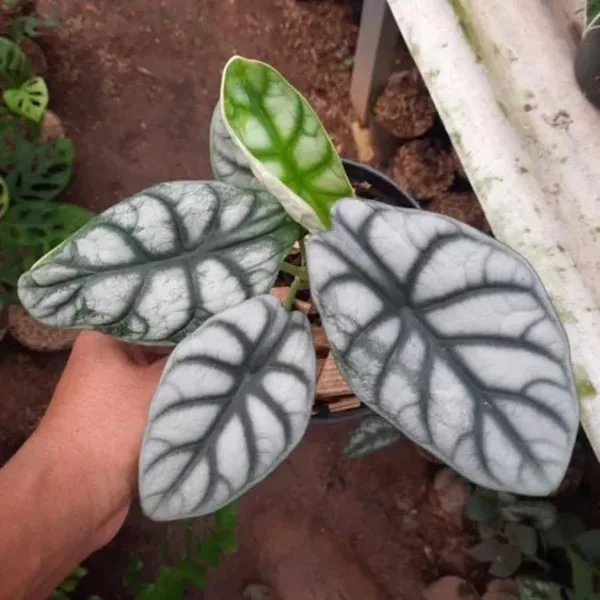
Alocasia baginda Silver Dragon is bought for the leaf and nothing else: an arrowhead blade so heavily silvered that the veins read as dark lines laid over metal, with a scalloped, near-black margin running the whole edge. The texture is stiff and slightly puckered, closer to a shield than to the soft foliage of an ordinary houseplant. It arrives small and stays small — this is a compact Alocasia that fits a shelf — and that combination of metallic leaf and modest size is exactly what makes it sell. Collectors who keep one almost always add a second.
Growing Alocasia baginda
- LightBright filtered light, no direct sunBright, filtered light with no direct sun on the blade. The silver veins read strongest under even, diffused light, and a leaf that catches midday sun scorches at the margin before it fades anywhere else. An east window is the simplest reliable position; a south window works if the light is broken by a sheer curtain.
- WaterKeep the mix evenly moist; let it dry only slightly at the surfaceKeep the mix evenly moist and never let it dry to the bottom of the pot. The plant runs on a corm, and a corm that dries out hard goes dormant rather than merely sulking — you lose the leaf canopy for a season. Let only the surface dry between waterings.
- Humidity60% – 80% relative humidity once acclimatised60% – 80% is the band it wants once it has hardened off, and it is the highest requirement in this group. In a dry room the leaf margins crisp and the silver dulls; a pebble tray or a grouped shelf does more for it than misting the blade.
- SubstrateChunky aroid mix — bark, perlite and coco coirA chunky aroid mix of bark, perlite and coco coir holds moisture without compressing around the corm. The pot wants to be barely wider than the corm, because a large volume of wet mix around a slow or dormant corm is how these plants rot. Repot only when the roots show at the drainage holes.
- Temperature18 °C – 28 °C18 °C – 28 °C keeps it in leaf. Below that range the plant is entitled to go dormant, and it will: the leaves yellow, then die back to the corm, and the pot looks empty for the season. Hold the warmth and the canopy stays.
- PropagationCorm or cormel division once the plant is establishedDivide a cormel from the parent corm at repotting, once the plant is established, and pot it on its own. Each cormel carries its own growth point, so a division is a separate plant rather than a cutting. Leave the parent corm intact and it will push offsets again.
It grows from a corm rather than a spreading root system, and that single fact explains most of its behaviour. In warmth it holds four or five leaves at a time and replaces them one by one; in a cool season it goes dormant, the canopy dies back, and the plant returns from the corm when the temperature climbs again. That makes it fussier than a trailing aroid and much more predictable than its reputation suggests — the plant is not dying when it disappears, it is resting. Keep the corm barely damp through dormancy and do not discard the pot.
Bare-root export and transit
Export suits this species less than a vine because the canopy is the part that suffers, but the corm travels well. Plants are lifted, washed free of substrate, dipped in an anti-fungal and bactericide solution, and the corm and root mass are wrapped in sterile Chilean AAA damp sphagnum before the plant goes into an EPS-insulated box inside a corrugated carton. That packing holds 18 °C – 24 °C and 70% – 85% relative humidity for the 7 – 10 day sealed transit, which is the same buffer the nursery runs at 18 °C – 32 °C outside the box. Expect leaf loss in transit; the corm is what arrives and what you pot.
How every consignment is prepared
- Root preparation100% Bare-root washed (zero soil, zero unsterilized peat).
- TreatmentSystemic broad-spectrum anti-fungal & bactericide dip treatment.
- Root wrapSterile Chilean AAA damp sphagnum moss protective root-envelope.
- Dispatch conditions to confirmConfirm root condition, packing method, route and arrival checks for Alocasia Baginda Silver Dragon. Transit estimates are planning information; recovery depends on stock condition and the receiving environment.
Questions buyers ask
Why has my Alocasia baginda Silver Dragon died back?
It has most likely gone dormant, which is normal behaviour for a corm-grown Alocasia in a cool season. The leaves yellow and die back, the pot sits empty, and the plant returns from the corm when the temperature is back in its range. Keep the corm barely damp, never wet.
Does it ship in leaf or as a dormant corm?
Either, and the packing is built for it. The corm is wrapped in sterile damp sphagnum inside an insulated box that holds a 7 – 10 day window, so the plant does not depend on keeping its canopy in transit. Do not read leaf loss on arrival as failure.
Is it a good plant for a low-light shelf?
No. It needs bright, filtered light and the highest humidity in this aroid group, so a dim shelf shortens its life. It is a compact plant, which makes it look like a shelf candidate, but the light requirement is what decides placement.
What the published literature calls this plant
A protologue is the original published description of a species. It helps you compare diagnostic characters — the features used to distinguish that species from similar plants. Compare those characters with photographs of the offered plant and its documented mother plant where available. A species description provides identification evidence; cultivation advice also needs evidence about growing conditions, as explained in the guidance above.
Alocasia baginda Kurniawan & P.C.Boyce · Araceae
The accepted name in the GBIF Backbone Taxonomy, the plant taxonomic backbone.
Protologue citation: Acta Phytotax. Geobot. 61: 123 (2011)
- In vitro Propagation of Alocasia baginda 'Silver Dragon’ through Direct and Indirect Organogenesis — Plant Tissue Culture and Biotechnology (2024)
Taxonomy from the GBIF Backbone Taxonomy. Open the backbone record.
Order Alocasia Baginda Silver Dragon
Supplied bare-root, washed free of substrate, graded A+ and wrapped in sterile damp sphagnum inside an insulated box with a 7 – 10 day transit window; the corm is the part that arrives. Minimum export order is 20 plants, volume discounts start at 30, and freight is quoted per volumetric box on the shipping page.
The commercial pages behind this guide
- How to import plants from IndonesiaThe full document-to-door sequence: bare-root preparation, Barantan certification, destination permits, inspection and arrival.
- Estimated shipping ratesFreight basis and indicative transit for a consignment, with the variables that move the price.
- Wholesale termsMinimum order, volume tiers, deposit, the document set, and the split of responsibility between exporter and importer.
- Live arrival guaranteeWhat the guarantee covers and how to report condition within the arrival window.